
ASUS Dual Radeon RX 9060 XT 16GB GDDR6
4.7Editor score
16GB GDDR6 memory
Axial-tech fan design
0dB silent technology
This guide compares the top graphics cards for ray tracing in 2026 focusing on performance cooling and features to help you choose the right GPU.
Choosing the right graphics card for ray tracing requires understanding architecture cooling and memory bandwidth. Modern games demand powerful hardware to render realistic lighting and reflections without sacrificing frame rates. We evaluate the top ten models available today to find the best balance.
Our analysis covers the latest NVIDIA Blackwell and AMD RDNA architectures alongside proven previous-generation options. We look at real-world performance metrics thermal solutions and feature sets like DLSS or FSR. Each product is ranked based on its ability to handle demanding ray traced workloads efficiently.
Every pick highlights key strengths and potential trade-offs to guide your purchase decision. Prices and availability change frequently so always check the latest listings before buying. This guide aims to simplify your search for the ultimate ray tracing experience in your next build.
4.7Editor score

4.6Editor score

4.8Editor score
The following table provides a side-by-side comparison of all ten graphics cards featured in this guide. We highlight critical specifications including memory size interface type and unique cooling technologies to help you quickly identify the model that best fits your system requirements and performance goals.




This graphics card stands out as the top choice for enthusiasts seeking the highest fidelity in ray traced environments. With a rating of 4.6 stars it delivers consistent performance in demanding titles. The integration of the NVIDIA Blackwell architecture ensures efficient handling of complex lighting calculations.
We may earn a commission when you buy through this link, at no additional cost to you.
The standout quality lies in its memory subsystem. Featuring 16GB of GDDR7 on a 256-bit interface it provides immense bandwidth for high resolution textures and ray tracing data. This prevents bottlenecks when rendering detailed scenes with global illumination and reflections. The WINDFORCE cooling system keeps temperatures in check during extended sessions.
While performance is stellar the card does demand significant power and budget. Users must ensure their power supply meets the requirements for the 16-pin connector. Additionally the cost reflects its flagship status which may not suit all builders. These trade-offs are acceptable for those prioritizing maximum visual quality above all else.
High-end gamers and content creators should buy this card for its unrivaled capabilities in ray tracing. It is the definitive choice for 4K gaming with full lighting effects enabled. We recommend it for anyone building a no-compromise system where visual fidelity is the primary goal.
The 16GB GDDR7 memory interface provides the speed necessary to load ray tracing data instantly without stuttering or frame drops.
The WINDFORCE cooling system ensures the GPU remains cool under heavy ray tracing loads maintaining boost clocks for longer durations.
We may earn a commission when you buy through this link, at no additional cost to you.
This model offers a compelling alternative for users preferring AMD technology. It achieves a high rating of 4.7 stars due to its robust build quality and cooling. The Radeon RX 9070 XT architecture focuses on delivering smooth frame rates in traditional rendering while supporting modern ray tracing capabilities.
We may earn a commission when you buy through this link, at no additional cost to you.
Key strengths include the massive 16GB GDDR6 memory which handles large assets effectively. The WINDFORCE cooling system utilizes Hawk Fans to maximize airflow and reduce noise. Server-grade thermal conductive gel ensures heat is transferred away from the GPU core efficiently preventing thermal throttling during intense gaming sessions.
However ray tracing performance lags slightly behind equivalent NVIDIA cards in some titles. Users may need to balance settings to maintain target framerates with ray effects enabled. These limitations are offset by the lower cost and excellent rasterization speed. This makes it a smart choice for budget-conscious gamers.
Gamers looking for a balance between price and performance should consider this card. It is ideal for 1440p gaming where ray tracing is desired but not the sole focus. We recommend it for those who value raw speed and cooling efficiency over exclusive features.
Server-grade thermal conductive gel significantly improves heat transfer allowing the GPU to sustain high clocks without overheating.
Hawk Fans are engineered to push more air through the fins ensuring quiet operation even when the card is under heavy load.
We may earn a commission when you buy through this link, at no additional cost to you.
The ASUS Prime edition brings reliability and quiet operation to the ray tracing arena. With a 4.6 star rating it is praised for its engineering precision. The card is designed to fit easily into smaller cases while maintaining excellent thermal performance for sustained gaming sessions.
We may earn a commission when you buy through this link, at no additional cost to you.
Axial-tech fans feature a smaller hub and longer blades to increase downward air pressure. A phase-change GPU thermal pad ensures optimal heat transfer lowering temperatures significantly compared to standard pads. The 2.5-slot design allows for greater build compatibility without sacrificing cooling efficiency in tight spaces.
One trade-off is the slightly higher price compared to standard models. Additionally it lacks some premium RGB features found on higher-end ASUS lines. These factors are acceptable for builders prioritizing silence and stability. The dual BIOS switch allows toggling between performance and quiet modes easily.
Small form factor enthusiasts should buy this card for its compact size and noiseless idle operation. It is perfect for users who want ray tracing without loud fan noise. We recommend it for those building a PC in a mini-ITX case who still demand high performance.
Phase-change thermal pads provide better contact between the GPU and heatsink ensuring consistent cooling under heavy workloads.
The dual BIOS switch lets you toggle between Quiet and Performance profiles for tailored acoustic and performance experiences.
We may earn a commission when you buy through this link, at no additional cost to you.
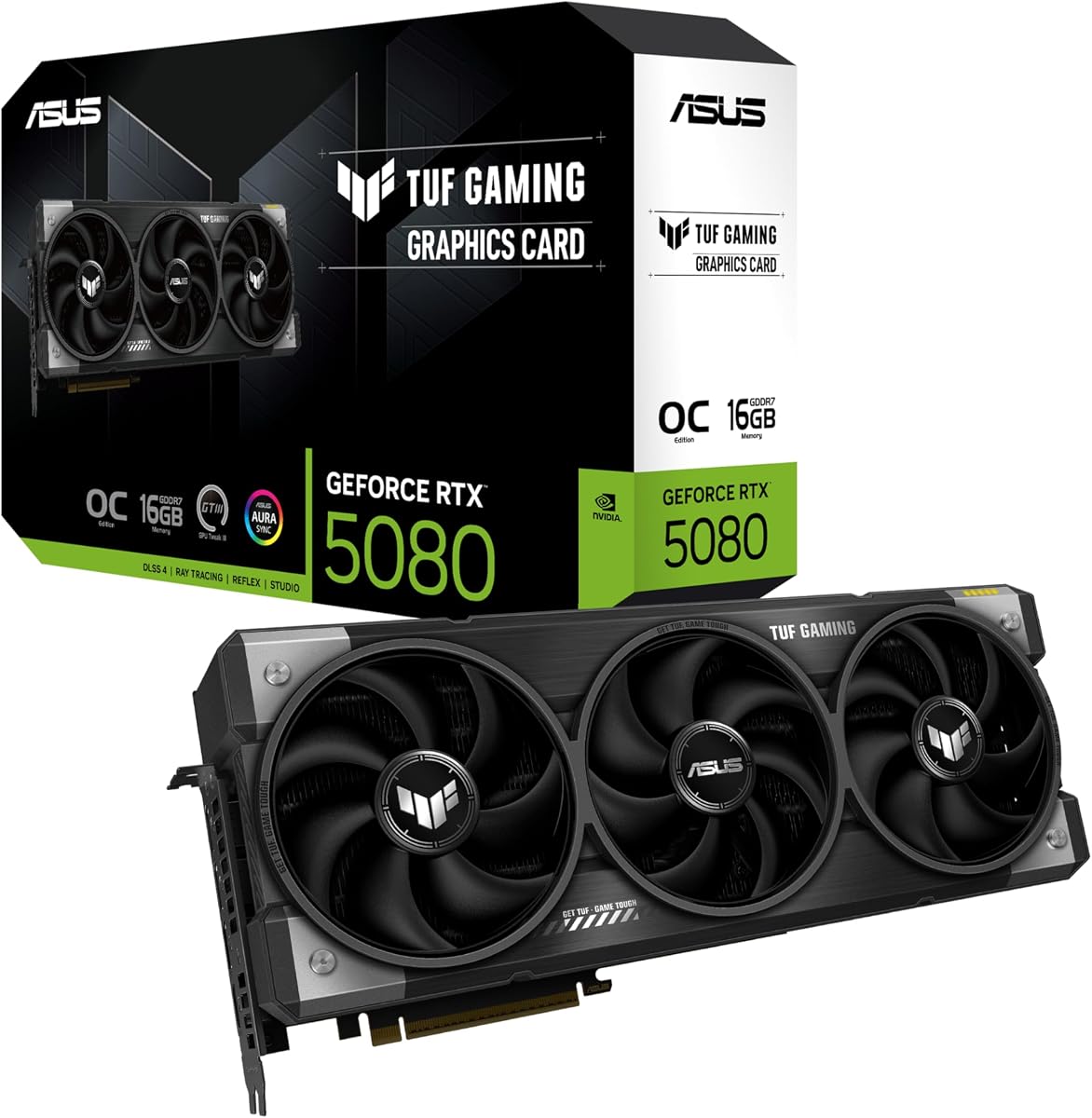
This model represents the peak of durability and performance for ray tracing enthusiasts. Rated at 4.6 stars it is built to withstand rigorous use over many years. The TUF Gaming branding guarantees military-grade components that deliver rock-solid power and longer lifespan than standard parts.
We may earn a commission when you buy through this link, at no additional cost to you.
A massive fin array optimized for airflow from three Axial-tech fans ensures exceptional cooling. The phase-change GPU thermal pad outlasts traditional paste ensuring optimal thermal performance even after years of heavy use. Protective PCB coating shields against moisture dust and debris preventing short circuits.
The card is physically large requiring 3.6 slots and clearance for 16-inch length. Users must verify case compatibility and power supply requirements before purchasing. These constraints are necessary for the card's robust engineering. For those with the space and power the reliability is unmatched.
Users seeking long-term reliability and high performance should buy this card. It is ideal for workstations or gaming rigs that run 24/7. We recommend it for anyone who values hardware longevity alongside top-tier ray tracing capabilities.
Military-grade components ensure rock-solid power delivery and longer lifespan for ultimate durability in demanding environments.
Protective PCB coating helps protect against short circuits caused by moisture dust or debris extending the card's life.
We may earn a commission when you buy through this link, at no additional cost to you.
This compact card offers impressive ray tracing capabilities in a smaller package. With a 4.7 star rating it is valued for its efficient design and AI performance. It delivers strong results in modern titles despite its physical size constraints compared to larger flagship models.
We may earn a commission when you buy through this link, at no additional cost to you.
Featuring 16GB of GDDR7 memory and 767 AI TOPS it handles complex compute tasks well. The 2.5-slot design maximizes compatibility in smaller chassis while maintaining cooling efficiency. Axial-tech fans with a barrier ring increase downward air pressure to manage heat effectively.
The card may run warmer than larger models due to its size. Noise levels are kept low by 0dB technology during light gaming. These trade-offs are acceptable for users with limited case space. The dual ball bearings ensure longevity despite the compact design.
Gamers with smaller cases should buy this card for its balanced performance and fit. It is perfect for compact builds that still need ray tracing features. We recommend it for users who need a powerful GPU that does not dominate the case space.
With 767 AI TOPS this card handles AI-driven features and upscaling tasks efficiently for smooth gameplay.
The 2.5-slot design maximizes compatibility and cooling efficiency for superior performance in small chassis.
We may earn a commission when you buy through this link, at no additional cost to you.
This card offers a strong balance of performance and durability for mid-range builders. Rated at 4.7 stars it provides consistent ray tracing results without the flagship price tag. It is designed to handle modern games efficiently while maintaining the rugged build quality of the TUF series.
We may earn a commission when you buy through this link, at no additional cost to you.
Military-grade components deliver rock-solid power and longer lifespan for ultimate durability. The phase-change GPU thermal pad ensures optimal thermal performance and longevity outlasting traditional paste. The GPU Guard and bracket secure the GPU reducing the risk of cracks and ensuring stable mounting.
It has slightly less memory than the higher tiers which may affect ultra settings. The larger slot count requires a spacious case. These factors are acceptable for the performance delivered. The Auto-Extreme manufacturing process ensures higher reliability across all units.
Users seeking durability and value should buy this card for its robust engineering. It is ideal for gamers who want reliable performance without breaking the bank. We recommend it for those who prioritize hardware quality and stable thermal performance.
Military-grade components deliver rock-solid power and longer lifespan ensuring ultimate durability during intensive use.
ASUS GPU Guard and bracket secure the GPU reducing the risk of cracks and ensuring stable mounting.
We may earn a commission when you buy through this link, at no additional cost to you.
This card is designed for quiet efficient gaming with substantial memory. With a 4.7 star rating it is praised for its low noise levels. It offers a capable ray tracing experience for those who prefer a peaceful gaming environment over raw power.
We may earn a commission when you buy through this link, at no additional cost to you.
The Axial-tech fans feature a barrier ring to increase downward air pressure for better cooling. The 0dB technology lets you enjoy light gaming in relative silence keeping the room quiet. Dual ball fan bearings last up to twice as long as sleeve bearing designs ensuring longevity.
Raw performance lags behind newer high-end cards but it handles moderate settings well. The larger memory helps with texture loading but does not boost ray tracing throughput. These limits are acceptable for quiet builds. The dual BIOS switch lets you toggle between Quiet and Performance profiles.
Noise-sensitive users should buy this card for its silent operation and durability. It is ideal for streamers or home theater PCs where sound matters. We recommend it for anyone prioritizing acoustics alongside decent graphics performance.
0dB technology lets you enjoy light gaming in relative silence reducing fan noise during low load scenarios.
Dual ball fan bearings last up to twice as long as standard sleeve bearing designs reducing maintenance needs.
We may earn a commission when you buy through this link, at no additional cost to you.
This card excels in performance and efficiency for high-end ray tracing tasks. Rated at 4.8 stars it delivers exceptional results in demanding titles. The TUF Gaming series ensures that the build quality matches the high performance with reliable thermal management.
We may earn a commission when you buy through this link, at no additional cost to you.
The phase-change GPU thermal pad ensures optimal thermal performance and longevity outlasting traditional thermal paste under heavy loads. Military-grade components deliver rock-solid power and longer lifespan for ultimate durability. Protective PCB coating helps protect against short circuits caused by moisture dust or debris.
It requires significant power and case clearance due to its size. Users should verify system requirements to ensure compatibility. These requirements are acceptable for the performance gain. The Auto-Extreme precision automated manufacturing helps ensure higher reliability across all units.
Power users seeking a balance of performance and durability should buy this card. It is ideal for high resolution gaming with detailed ray traced effects. We recommend it for those who need a powerful card that will last for years.
Phase-change thermal pad ensures optimal thermal performance and longevity outlasting traditional thermal paste for graphics cards under heavy loads.
Military-grade components deliver rock-solid power and longer lifespan for ultimate durability in challenging conditions.
We may earn a commission when you buy through this link, at no additional cost to you.
This card offers a strong performance to price ratio for gamers. With a 4.8 star rating it is highly recommended for efficient ray tracing. It integrates the NVIDIA Blackwell architecture to handle modern games with advanced lighting features effectively.
We may earn a commission when you buy through this link, at no additional cost to you.
Powered by the NVIDIA Blackwell architecture and DLSS 4 it delivers high frame rates and efficient rendering. The integrated 12GB GDDR7 192-bit memory interface provides fast access to textures. PCIe 5.0 support ensures future compatibility with new motherboard standards.
The WINDFORCE cooling system maintains stable temperatures during long sessions. While bandwidth is lower than higher tiers it handles 1440p gaming well. These limits are acceptable for the price point. The design ensures longevity and consistent performance over time.
Budget-conscious gamers should buy this card for its high rating and value. It is ideal for 1440p enthusiasts who need solid ray tracing. We recommend it for anyone looking for reliable performance without a premium price tag.
PCIe 5.0 support ensures future compatibility with new motherboard standards and faster data transfer speeds.
Powered by the NVIDIA Blackwell architecture and DLSS 4 it delivers high frame rates and efficient rendering.
We may earn a commission when you buy through this link, at no additional cost to you.
This model provides proven reliability with efficient cooling for ray tracing. Rated at 4.8 stars it remains a favorite for builders who want stability. The Ada Lovelace architecture offers full ray tracing support and efficient frame generation for smooth gameplay.
We may earn a commission when you buy through this link, at no additional cost to you.
Powered by NVIDIA DLSS 3 ultra-efficient Ada Lovelace arch and full ray tracing it delivers great visual fidelity. IceStorm 2.0 Advanced Cooling keeps temperatures low with active fan control. Spectra RGB Lighting adds customization while the compact design fits various cases.
It uses PCIe 4.0 and GDDR6X which is slightly slower than newer standards. Some games may benefit from the newer GDDR7. These trade-offs are acceptable for the price and features. The metal backplate adds structural strength and cooling aid.
Users wanting a compact card with proven performance should buy this option. It is ideal for those who value frame generation and RGB. We recommend it for gamers seeking a reliable card that fits in smaller builds.
IceStorm 2.0 Advanced Cooling ensures optimal thermal management with active fan control to maintain low temperatures.
Powered by ultra-efficient Ada Lovelace architecture and full ray tracing it offers stable performance in modern titles.
We may earn a commission when you buy through this link, at no additional cost to you.
Selecting the right graphics card involves balancing raw power efficiency and specific features. We break down the key factors to consider before making your purchase decision for ray tracing performance.
Modern GPUs rely on specific architectures like NVIDIA Blackwell or AMD RDNA to handle ray tracing calculations efficiently. These architectures include dedicated hardware cores that accelerate light path calculations reducing the load on standard shaders. Choosing a newer generation ensures you get the latest improvements in this technology.
Look for cards with the latest architecture to maximize frame rates while keeping ray effects enabled.
Ray tracing demands significant video memory to store detailed textures and lighting data. Cards with 16GB of memory generally handle high resolution and high quality settings better than those with 12GB. The memory type such as GDDR7 offers faster bandwidth to prevent bottlenecks.
Prioritize models with at least 16GB of memory if you plan to game at 4K with ray tracing.
Sustained ray tracing workloads generate substantial heat which can throttle performance if not managed. Advanced cooling systems like Axial-tech fans or WINDFORCE ensure the GPU stays within safe temperatures. Look for features like phase-change thermal pads for better heat transfer.
A robust cooling system ensures the card maintains its boost clocks for longer periods during intense gaming.
The memory interface width determines how much data can move between the GPU and memory simultaneously. Wider interfaces like 256-bit allow for higher bandwidth which is crucial for ray traced frames. This helps maintain smooth frame rates when lighting calculations are heavy.
Choose a card with a wide memory interface to ensure data flows quickly during complex rendering.
High performance GPUs require sufficient power to operate correctly without causing system instability. Cards with newer architectures often need specific power connectors like the 16-pin 12V-2×6. Ensure your power supply unit meets the minimum wattage and connector requirements.
Verify your power supply can support the card to avoid unexpected shutdowns during gameplay.
Larger cooling solutions increase the physical footprint of the graphics card. Models may range from 2.5 slots to 3.6 slots in width and vary significantly in length. You must check your case dimensions to ensure the card fits without obstructing other components.
Measure your case clearance carefully before buying to prevent installation issues and compatibility problems.
Ray tracing can be computationally expensive so upscaling technologies help maintain high frame rates. Look for support for DLSS or FSR which can significantly boost performance with minimal quality loss. These features are often integrated into the graphics drivers or proprietary software.
Check if the card supports the latest upscaling technologies to optimize your ray tracing experience.
Durable components like military-grade capacitors and double ball bearings extend the life of the graphics card. Features such as protective PCB coating help prevent damage from dust and moisture. Investing in a card with strong build quality reduces the risk of hardware failure.
Prioritize models with premium build features to ensure your investment lasts for several years.
Ensure your power supply meets the wattage and connector requirements to prevent instability. Use a 16-pin connector if your card supports it and verify all power cables are firmly connected before powering on the system.
Install the latest drivers from the manufacturer to enable all ray tracing features and performance optimizations. Use software like GPU Tweak III to monitor temperatures and adjust fan curves for your specific case airflow.
Keep your system clean by regularly dusting the fans and heatsinks to maintain cooling efficiency. Monitor GPU temperatures during gameplay to ensure they remain within safe limits and adjust in-game settings if overheating occurs.
A good ray tracing card features dedicated hardware cores efficient memory bandwidth and effective cooling. These elements ensure smooth frame rates without overheating. The latest architectures provide the best performance for these complex calculations.
While 12GB is sufficient for many games 16GB is recommended for 4K or high texture settings. More VRAM prevents stutters when loading detailed assets. It ensures a smoother experience in open world titles with ray tracing.
NVIDIA Blackwell and AMD RDNA 3 are currently the top choices for efficiency and performance. These architectures include dedicated cores for light path calculations. Newer generations generally offer better ray tracing results per watt of power.
Yes ray tracing adds significant computational load compared to standard rendering. This is why features like DLSS or FSR are essential for maintaining high framerates. Balancing settings allows you to enjoy the visuals without lag.
Older cards can support ray tracing but often lack the cores for smooth performance. They may struggle at higher resolutions or with multiple effects enabled. Modern cards are optimized to handle these workloads efficiently.
Power requirements vary but many high end cards need at least 850W of reliable power. Ensure your power supply has the correct connectors for stable operation. Adequate power prevents throttling during intense gaming sessions.
We highlighted the top ten models that excel in ray tracing performance and build quality. The GIGABYTE RTX 5080 stands out as our top pick for enthusiasts seeking the highest fidelity.
Consider your specific needs such as case size and power supply before finalizing your choice. Durability and cooling performance are just as important as raw specs for long-term satisfaction.
Prices and availability change frequently so always check the latest listings before buying to ensure you get the best deal today.