This guide compares the top Arduino ADC boards for precision sampling, featuring ADS1115 and ADS1256 modules for diverse sensor and data acquisition projects.
As an Amazon Associate we earn from qualifying purchases. We may earn a commission when you buy through links on this page, at no additional cost to you. Read our affiliate disclosure.As an Amazon Associate we earn from qualifying purchases.Purchases through our links may earn us a commission, at no extra cost to you. Read our affiliate disclosure.
Choosing the right analog-to-digital converter is essential for any maker working with sensors. An Arduino ADC board expands the capabilities of microcontrollers by allowing precise measurement of voltage signals that standard pins cannot read accurately.
We evaluated ten highly rated modules based on resolution, channel count, communication protocols, and user feedback. Our analysis focuses on real-world performance for data logging, sensor interfacing, and industrial monitoring applications.
Each pick highlights specific strengths like programmable gain, sampling speed, or price efficiency. Please note that pricing and availability fluctuate frequently, so verify current details before making your final purchasing decision for your project.
Top 3 Picks for Best Arduino ADC Board
Best Budget
HiLetgo ADS1115 16 Bit 16 Byte 4 Channel I2C IIC Analog-to-Digital ADC PGA Converter with Programmable Gain Amplifier High Precision ADC Converter Development Board for Arduino Raspberry Pi
The following table provides a side-by-side comparison of all ten selected ADC modules, highlighting key specifications such as resolution, sampling rate, input channels, and voltage requirements to help you decide quickly.
This module is a top choice for precise analog measurements. It offers 16-bit resolution and a wide voltage range from 2.0V to 5.5V, making it versatile for many microcontrollers. The included PGA allows for accurate low-voltage sensing.
Pros
High precision 16-bit conversion
Wide operating voltage range
Programmable gain amplifier included
Multiple units in pack
Compatible with Raspberry Pi
Cons
Requires external header soldering
I2C speed limitations
We may earn a commission when you buy through this link, at no additional cost to you.
The ADS1115 chip inside provides stable readings up to 860 samples per second. Its internal PGA is excellent for amplifying small signals like those from thermocouples. The wide supply range ensures reliable operation with both 3.3V and 5V systems.
While the I2C bus has limits on speed and addressing, this board is highly reliable for most sensor projects. The need to solder headers might be a minor hurdle for beginners, but it saves space and improves connections.
If you need accurate ADC conversion for data logging or sensor interfacing, this kit is a great investment. Buying three at once ensures you have spares for future projects or classroom sharing.
Precision Analog Conversion
The 16-bit resolution allows for extremely fine voltage detection, resolving changes down to microvolts depending on the gain setting.
Wide Voltage Flexibility
Operating between 2.0V and 5.5V means it works seamlessly with 3.3V logic like ESP8266 or 5V Arduino boards without extra level shifters.
The ADS1256 offers exceptional resolution for high-precision measurement tasks. With 24-bit conversion, it captures minute voltage changes that standard 12-bit or 16-bit ADCs might miss.
Pros
True 24-bit precision
8 input channels available
Low nonlinearity error
Integrated reference voltage
Differential input options
Cons
Requires SPI setup
Max input range is 3V
We may earn a commission when you buy through this link, at no additional cost to you.
Its onboard reference voltage ensures consistent readings without external components. The module supports both single-ended and differential inputs, giving flexibility for various sensor types including strain gauges.
While the SPI interface is more complex than I2C, it provides faster data throughput for real-time applications. The limitation to 3V analog inputs means you must scale signals properly if using higher voltages.
Ideal for industrial monitoring or scientific experiments requiring exact numbers, this board delivers professional-grade performance at an accessible price point for makers.
Industrial Grade Precision
With 24-bit resolution, this module resolves changes down to fractions of a microvolt, making it ideal for high-end measurement needs.
Differential Input Support
Supporting 4 differential inputs helps reject common noise, improving signal integrity when working with long sensor cables or noisy environments.
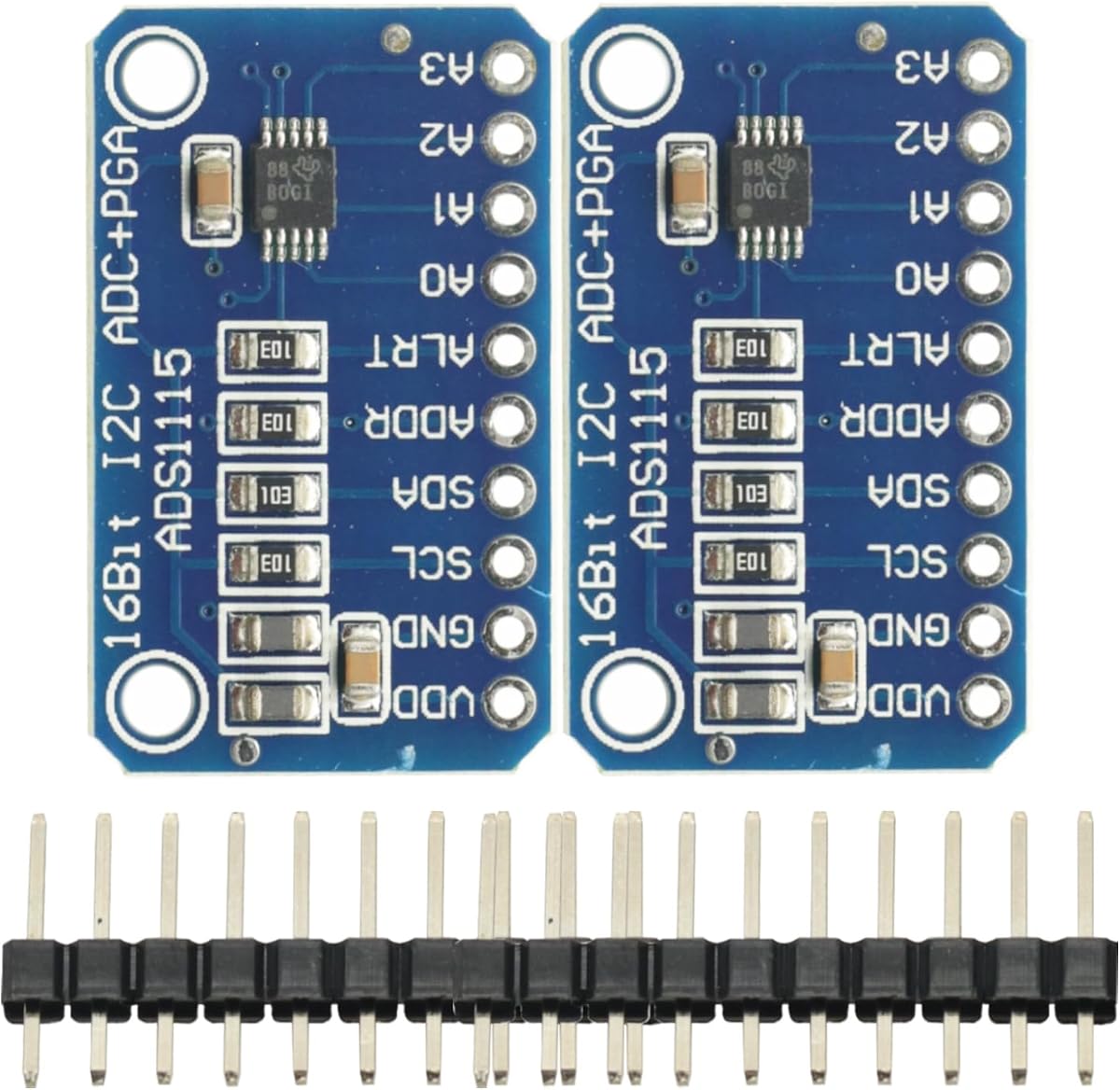
This two-pack provides excellent value for projects needing multiple ADC points. Each board features the reliable ADS1115 chip with 16-bit resolution and programmable gain for versatile sensing applications.
Pros
Perfect for multiple sensors
High user rating
Integrated PGA for sensitivity
Easy I2C integration
Affordable two-pack pricing
Cons
Standard header only
Not waterproofed
We may earn a commission when you buy through this link, at no additional cost to you.
The high user rating suggests consistent quality and reliable performance out of the box. The wide input voltage range supports both 3.3V and 5V logic levels seamlessly.
The primary trade-off is the basic plastic header configuration which requires care during soldering. However, this simplicity helps reduce production costs for the end user.
For anyone building a sensor network or needing a backup module, buying two units ensures redundancy and keeps costs low without sacrificing accuracy.
High Sensitivity Sensing
The programmable gain amplifier allows you to adjust input ranges, ensuring precise readings even from very small voltage signals.
I2C Simplicity
Using just two wires for communication makes wiring clean and simple, reducing clutter on your breadboard or custom PCB design.
This kit offers the most affordable entry point for ADC expansion. You get three reliable modules that provide 16-bit resolution and a wide 2.0V to 5.5V power range.
Pros
Low price per unit
Built-in PGA
Wide supply range
Comparator mode for alerts
Suitable for Raspberry Pi
Cons
Basic board layout
Requires header soldering
We may earn a commission when you buy through this link, at no additional cost to you.
The comparator mode adds a useful feature for monitoring thresholds, allowing the module to trigger interrupts based on voltage levels. The PGA helps in reading low-voltage signals accurately.
While the board design is straightforward, it gets the job done efficiently. You will need to solder headers for best use, which is standard for these modules.
If you need multiple units for classroom use or prototyping many sensors without breaking the bank, this budget-friendly pack is an ideal solution.
Comparator Mode Utility
Comparator mode allows you to set voltage thresholds for alarms without continuous polling, saving CPU resources in your main microcontroller code.
Economical Bulk Purchase
Buying three units at a time lowers the cost per module significantly, making it perfect for large-scale deployments or backup inventory.
With four boards included, this option is great for scaling up sensor arrays. Each board offers 16-bit precision and supports both single-ended and differential signals effectively.
Pros
Excellent bulk value
Internal oscillator for timing
Auto shut down feature
Differential input support
Wide voltage compatibility
Cons
Variable user ratings
Standard I2C speed
We may earn a commission when you buy through this link, at no additional cost to you.
The internal oscillator eliminates the need for an external crystal, simplifying design. Auto shut down helps save power in battery-powered applications by reducing current draw when idle.
While ratings vary slightly, the core functionality remains robust for most hobbyist and educational projects. The differential input mode helps reduce noise interference from external sources.
Consider this kit if you are building a large environmental monitoring system and need multiple independent ADC channels across different locations.
Power Saving Features
Auto shut down reduces power consumption significantly when not actively sampling, extending battery life in remote monitoring stations.
Flexible Input Modes
Supporting both single-ended and differential inputs means you can connect a wider variety of sensors without needing extra hardware.
This board is highly praised for its seamless integration with Raspberry Pi systems. It adds analog input capability to a platform that lacks native ADC pins entirely.
Pros
Perfect for Pi GPIO
Excellent reliability
Flexible gain settings
Wide supply range
Multiple address options
Cons
Requires soldering headers
Small form factor
We may earn a commission when you buy through this link, at no additional cost to you.
The 16-bit resolution ensures accurate measurements for projects like weather stations or home automation. The wide input range allows for direct connection to various analog sensors.
While the module is small, its functionality is packed efficiently. You will need to solder headers to plug it into a breadboard reliably.
If you are working on a Pi-based project requiring analog data, this module offers the performance and flexibility you need without additional complexity.
Pi GPIO Expansion
Raspberry Pi users get native support through I2C, allowing easy connection without needing extra hardware bridges or converters.
Reliable Communication
The I2C protocol ensures stable data transfer between the ADC and microcontroller, even over longer wires within a single device.
This set focuses on quality construction with ENIG plating for better solderability and durability. It is ideal for long-term projects where reliability matters most.
Pros
Gold plating resistance
Lead-free construction
Multi-module addressing
Pre-soldered headers
Designed for reliability
Cons
Higher price point
Fewer units in pack
We may earn a commission when you buy through this link, at no additional cost to you.
The ability to chain up to four modules provides 16 channels of precision input. This is useful for complex IoT nodes needing many sensors in one unit.
While it costs more per unit, the build quality justifies the investment. Pre-soldered headers save time and ensure secure connections from the start.
Choose this option if you need robust components that will withstand soldering stress or environmental wear better than standard green board modules.
Enhanced Durability
ENIG plating resists oxidation and corrosion, ensuring connections remain strong even after repeated soldering cycles or exposure to elements.
Multi-Module Networking
Unique address pins allow chaining multiple boards on one bus, scaling your project to 16 channels without needing extra microcontrollers.
This module stands out for its 200KHz sampling rate, making it suitable for capturing fast-moving signals. The 8 channels sample simultaneously for consistent multi-point data.
Pros
High sampling frequency
Synchronized sampling
8 independent channels
Wide voltage range
Parallel data output
Cons
Complex SPI setup
Limited user feedback
We may earn a commission when you buy through this link, at no additional cost to you.
The parallel and serial output options offer flexibility in how you handle data. Internal voltage reference ensures stable readings across various input levels.
The 3.3V control signal requirement means you must match your microcontroller's logic levels. Setup is more involved compared to simpler I2C boards.
Ideal for vibration analysis or audio sampling, this board delivers speed and synchronization that standard ADCs cannot match at this price range.
Fast Sampling Speed
Sampling at 200KHz allows you to capture transient signals accurately, which is crucial for analyzing dynamic events like motor vibrations.
Simultaneous Input Capture
All eight channels sample at the exact same time, ensuring phase coherence in multi-sensor data acquisition tasks.
This set of four boards is a strong choice for scaling up projects. Each module delivers stable readings and integrates well with most Arduino platforms.
Pros
Stable readings
Multiple unit value
Integrated gain amplifier
Simple I2C wiring
Great for DIY
Cons
Requires header soldering
Limited to 16-bit
We may earn a commission when you buy through this link, at no additional cost to you.
The built-in PGA enhances sensitivity for low-voltage sensors. I2C integration keeps wiring simple and reduces pin usage on your main controller.
You may need to solder headers for best use, but the performance justifies the effort. This set is perfect for DIY electronics and classroom labs.
If you plan to monitor multiple zones or build a distributed sensor network, having four units ready makes development and deployment much easier.
Simplified Wiring
With just SDA and SCL lines needed, you avoid crowding your microcontroller pins, leaving more space for other components.
Consistent Performance
Stable readings across different units ensure that data from multiple locations remains comparable and reliable over time.
This single module is perfect for testing or small projects where bulk isn't needed. It provides 16-bit precision and a wide supply range for flexible setup.
Pros
Affordable single unit
Comparator mode
Programmable gain
Easy integration
Reliable precision
Cons
Single unit only
Basic layout
We may earn a commission when you buy through this link, at no additional cost to you.
The comparator mode allows threshold monitoring without constant polling. I2C interface makes it easy to add to existing circuits without rewiring.
While you only get one board, it offers all the essential features needed for accurate ADC conversion. The gain amplifier helps optimize signal quality for your specific needs.
If you just need one ADC channel to validate a design or add a single sensor to an existing system, this module is an efficient and cost-effective solution.
Threshold Detection
Comparator mode helps detect voltage thresholds automatically, which is useful for alerts or safety monitoring without CPU intervention.
Compact Integration
The compact board design fits easily into tight spaces, making it suitable for retrofitting sensors into existing enclosures.
We may earn a commission when you buy through this link, at no additional cost to you.
Buying Guide – How to Choose the Best Arduino ADC Board
Selecting the right ADC module depends on your specific project needs. Here are key factors to consider to ensure you choose the perfect board.
Resolution and Precision
Resolution determines the smallest voltage change the ADC can detect. Higher bit counts like 24-bit offer finer granularity than 12-bit or 16-bit modules. For high-precision tasks like weighing scales, go for 24-bit.
Always match resolution to your application needs to avoid overpaying for unnecessary precision.
Input Channels
Consider how many sensors you need to connect simultaneously. Most modules offer 4 channels but some high-end models provide 8 or more. Multi-channel boards reduce the need for multiplexers.
More channels allow scaling your projects without adding extra hardware complexity.
Communication Protocol
I2C is simpler and uses fewer pins while SPI offers faster data transfer speeds. Choose I2C for general use and SPI when you need higher throughput.
Check your microcontroller's available pins and speed requirements before deciding on a protocol.
Input Voltage Range
Ensure the module accepts the voltage levels your sensors output. Many boards support 0-5V or ±10V ranges. Operating range compatibility prevents damage and ensures accurate readings.
Verify voltage compatibility with your power supply and sensor output limits.
Programmable Gain Amplifier
A PGA allows you to amplify small signals before conversion improving precision for low-voltage sensors like thermocouples. Not all boards include this feature.
Look for boards with PGA when dealing with microvolt-level sensor signals.
Sampling Rate
Higher sampling rates capture fast changing signals effectively. Slow sensors like temperature probes need less speed than audio or vibration sensors.
Match sampling rate to the dynamic nature of the signals you intend to measure.
Package and Quantity
Buying in packs offers better value for larger deployments. Check if the pack includes headers or requires soldering.
Gold plated boards offer better oxidation resistance and durability. Standard green boards are cheaper but may wear faster in harsh environments.
Invest in higher quality for projects requiring long-term reliability.
How to Use and Care for Your Arduino ADC Board
Begin by connecting the module to your microcontroller's I2C or SPI pins carefully. Verify connections match the datasheet to avoid short circuits.
Install the appropriate library like Wire or SPI and run example code to test basic functionality. Ensure the voltage levels match your board logic.
Keep the module dry and avoid touching solder points directly. Regularly check connections for stability and update code for improved efficiency.
Frequently Asked Questions
What is the main advantage of an external ADC for Arduino?
External ADCs provide higher resolution and precision than internal ones, allowing accurate measurement of small voltage changes that standard pins cannot detect reliably.
Can these boards work with ESP32 and Raspberry Pi?
Yes most boards like the ADS1115 are compatible with ESP32 and Raspberry Pi. They use I2C or SPI which both platforms support natively.
Do I need to solder headers before using them?
Most modules come without headers. Soldering them yourself ensures stable connections and prevents damage when plugging into breadboards or other boards.
What is the difference between 16-bit and 24-bit ADC?
24-bit ADCs resolve smaller voltage steps than 16-bit. This makes them ideal for high precision tasks like strain gauges where microvolt differences matter.
How do I power the ADC module correctly?
Check the board specification for voltage range. Most accept 3.3V to 5V. Connect VCC and GND properly to avoid damage or incorrect readings.
Can I chain multiple ADC modules together?
Yes modules like ADS1115 have address pins allowing up to four devices on one I2C bus. This scales input capacity without extra microcontrollers.
What is a programmable gain amplifier?
A PGA amplifies small input signals before conversion making them easier to read. It adjusts the input range for better precision on low voltage signals.
Why does my ADC give noisy readings?
Noise often comes from wiring or power issues. Use shielded cables and stable power supplies to reduce interference and ensure cleaner data.
Final Thoughts on Choosing the Best Arduino ADC Board
The Teyleten Robot ADS1115 3-Pack stands out as the top overall choice for its balance of precision reliability and value. It handles most sensor tasks effectively.
For high resolution projects the HiLetgo ADS1256 offers unmatched 24-bit accuracy for industrial needs. Budget users should consider the HiLetgo 3pcs ADS1115 pack.
Always verify current pricing and compatibility with your setup before buying. These modules significantly expand your project capabilities for data acquisition.
This guide compares the top AI voice recorder with transcription models for meetings and interviews, highlighting accuracy, battery life, and privacy features.