
Askar 71F Flat-Field Telescope
4.9Editor score
Quadruplet air-spaced APO
Lightweight 2.5kg design
Integrated field flattener
This guide compares the top ten apochromatic refractors for visual astronomy and astrophotography based on optical quality, build, and user ratings.
Apochromatic refractors represent the pinnacle of optical design for serious astronomers seeking crisp, color-free views of the night sky. These telescopes use specialized glass to minimize chromatic aberration, ensuring stars appear as sharp points rather than colored halos. Whether you are imaging deep sky objects or enjoying visual observation, choosing the right APO is crucial for your success.
To compile this list, we analyzed user feedback, optical specifications, and build quality across ten leading models available today. We focused on factors like glass type, focal ratio, and included accessories to help you find the best match for your needs. Each product was selected for its reputation in the community and consistent performance in real-world scenarios.
Each entry in this guide highlights key strengths, potential drawbacks, and ideal use cases for every telescope listed. Please note that product availability and pricing can change frequently, so we recommend verifying current details before making a purchase decision. Our goal is to provide a clear path to finding the perfect apochromatic refractor for your specific setup and budget.
4.9Editor score

4.5Editor score

4.2Editor score
The following table provides a side-by-side comparison of all ten apochromatic refractors featured in this guide. Use this overview to quickly assess key specifications like aperture, focal ratio, and included accessories before diving into the detailed reviews.




The SVBONY SV550 AP0 stands out as a premier choice for those seeking high-quality apochromatic performance at a reasonable cost. With a 4.5-star rating, users praise its ability to deliver bright, high-contrast images free from chromatic aberration. This OTA is designed for serious observation and imaging, offering a robust triplet optical structure that ensures clarity across the field of view.
We may earn a commission when you buy through this link, at no additional cost to you.
Its air-spaced triplet design uses S-FPL51 low-dispersion glass to effectively eliminate blue-edge chromatic aberration. The dual-speed toothed focus mount provides precise control, which is essential for capturing sharp images with full-frame cameras. Additionally, the extreme extinction measures inside the barrel help reduce stray light, enhancing contrast for deep sky targets.
While the optical performance is exceptional, users should note that this is an OTA-only package. You will need to source a separate mount, finder, and accessories to get started. The lack of a dew shield may require an aftermarket addition for extended sessions in humid conditions. However, these trade-offs are acceptable given the optical quality delivered.
This telescope is ideal for intermediate to advanced astrophotographers who want a lightweight, high-performance OTA. If you value color accuracy and sharpness over convenience, the SV550 AP0 is a strong recommendation. It pairs well with various mounts and accessories, making it a versatile addition to any astronomy setup.
The triplet apochromatic optics structure effectively improves the blue-edge chromatic aberration problem found in single-ED designs, ensuring true-to-life color rendition.
The magnesium alloy dual-speed focus mount reduces vignetting on full-frame cameras while maintaining structural integrity and reducing overall weight.
We may earn a commission when you buy through this link, at no additional cost to you.
The Explore Scientific ED80 Essential Series offers a reliable and well-rounded experience for both visual observers and photographers. Its combination of genuine FCD1 HOYA extra-low dispersion glass and enhanced multi-layer coatings produces views filled with stunning detail. This makes it a favorite for capturing the Moon, planets, and deep sky objects with high fidelity.
We may earn a commission when you buy through this link, at no additional cost to you.
Designed with portability in mind, the 80mm aperture and f/6 focal ratio make it easy to transport for spontaneous stargazing sessions. The push-pull adjustments on the front cell ensure precise collimation, which is crucial for maintaining tight star shapes. USA-based support adds peace of mind for buyers concerned about warranty and service.
While highly capable, the scope can be slightly heavier than some budget alternatives, which might matter for travel. The dew shield is retractable, which is convenient, but users should ensure it is fully extended during use to prevent dew formation. Overall, it remains a solid choice for those prioritizing optical quality and brand reputation.
Buy this if you want a reputable brand with strong customer support and excellent optics. It is suitable for beginners looking to upgrade their system or experienced imagers needing a reliable guiding or imaging scope. The balance of performance and usability makes it a worthy contender in the 80mm category.
Proprietary enhanced multi-layer coatings on all optical surfaces work with FCD1 HOYA glass to produce excellent views filled with stunning details.
The front cell is outfitted with push-pull adjustments to get the best collimation for the tightest stars, ensuring optimal image quality.
We may earn a commission when you buy through this link, at no additional cost to you.
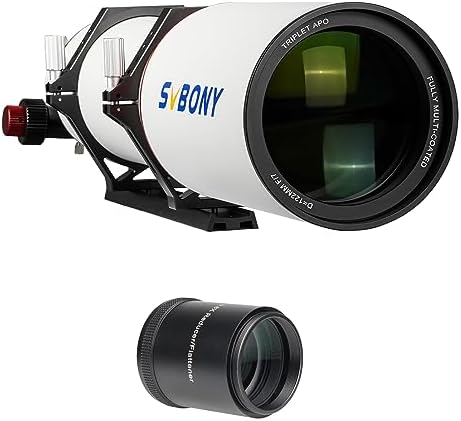
This bundle offers a complete solution for deep sky astrophotography with the SVBONY SV550 telescope. The inclusion of the SV209 Field Flattener ensures that the field is corrected, which is critical for sharp stars across the entire sensor. With a perfect 5.0 rating, users are highly satisfied with the optical performance and convenience of this package.
We may earn a commission when you buy through this link, at no additional cost to you.
The SV209 is equipped with an M63 extension tube and an M48 adapter ring to ensure that the back focal length is the standard 55mm. This supports both half-frame and full-frame cameras, making it versatile for various setups. The magnesium alloy focuser reduces weight by more than 20% compared to aluminum, easing the load on your mount.
While the bundle includes essential imaging tools, it does not come with a mount or guide scope, so you will need to source those separately. The hollow dovetail plate makes operation easy, but ensure all accessories are securely tightened. The high extinction barriers inside the barrel help maintain image contrast, which is a significant plus for faint targets.
This is an ideal pick for those ready to start serious astrophotography without hunting for compatible parts separately. The 55mm back focus standard simplifies setup, and the high ratings confirm reliability. If you want a streamlined path to capturing deep sky images, this bundle provides the core components you need.
The SV209 Field Flattener corrects the field curvature, ensuring sharp stars from the center to the edge of your camera sensor.
The magnesium alloy focuser reduces weight significantly compared to aluminum, making the telescope easier to balance and carry.
We may earn a commission when you buy through this link, at no additional cost to you.
The SVBONY SV550 122mm offers a significant step up in aperture for those needing more light gathering power. Its 122mm aperture allows for clearer and more detailed images, making it suitable for fainter deep sky objects. The N/A rating reflects that it is a newer or less reviewed option, but the specifications promise high performance for serious enthusiasts.
We may earn a commission when you buy through this link, at no additional cost to you.
The 122mm aperture adopts a FPL-51 triplet apochromatic lens structure containing one piece of ED glass. This lens provides better correction of aberration and greatly reduces chromatic aberration, enhancing clarity and sharpness. The portable handle and SV211 dovetail base make carrying and moving this large-aperture telescope much easier than expected.
At 6.44kg, the OTA is manageable but requires a robust mount. The handle adds convenience for transport, but users should still take care during setup. While reviews are scarce, the build quality and optics follow the high standards of the SV550 series. It is a compelling choice for those needing extra aperture.
Consider this model if you have outgrown 80mm scopes and need more light for imaging or visual observation. The included handle is a thoughtful touch for a larger scope. Ensure your mount can handle the weight, and you will benefit from the improved limiting magnitude and image detail.
The 122mm aperture gathers more light, allowing for more clear and detailed images suitable for deep sky photography and observation.
The SV211 dovetail base features a comfortable and convenient carrying handle for the large-aperture telescope.
We may earn a commission when you buy through this link, at no additional cost to you.
The Askar 71F is an excellent option for those seeking affordability without sacrificing quality. With a 4.9 rating, it is praised for being lightweight and versatile, weighing only 2.5kg. Its quadruplet air-spaced APO design ensures high optical performance, making it suitable for both deep sky astrophotography and visual astronomy.
We may earn a commission when you buy through this link, at no additional cost to you.
The entire lens barrel uses high-quality CNC processing and interior matte paint to reduce stray light reflection. A key feature is the ability to rotate the focus 360 degrees for perfect camera alignment without tube rotation. It serves as an affordable and high-quality versatile self-flattened OTA for users looking to discover more beautiful deep sky targets.
While the 71mm aperture limits light gathering compared to 80mm or 122mm scopes, it is compact enough for travel. The self-flattened design simplifies imaging setups by reducing the need for extra accessories. Visual observers might need an erector prism, but for photographers, this is a complete package. The balance of performance and price is unmatched.
This is the best budget choice for astrophotographers starting their journey. It is easy to carry and use, with practical design elements that save money and time. If you need a versatile OTA that fits easily into a car trunk and delivers sharp results, the Askar 71F is highly recommended.
The 71F takes practicality and versatility into full consideration, with weight and size effectively controlled for easy carrying and use.
Just loosen the screws to rotate the focus 360 degrees, achieving perfect astronomical shooting composition without rotating the tube.
We may earn a commission when you buy through this link, at no additional cost to you.
The SVBONY SV503 offers a larger 102mm aperture for superior light gathering and detail. With an FMC coating, it delivers brighter, higher-contrast images for both astrophotography and visual observation. The S-FPL51 ED glass minimizes color fringing, ensuring true-to-life color and sharp detail perfect for planetary observation and deep-sky imaging.
We may earn a commission when you buy through this link, at no additional cost to you.
A built-in 360° field rotator allows perfect camera alignment without tube rotation, which is very convenient for framing. Coupled with the smooth dual-speed focuser, achieving critical focus is effortless. The 90mm focus travel enables precise focusing even when used with astrophotography accessories such as filter wheels and field flatteners.
The aluminum retractable hood actively blocks stray light and prevents dew formation, protecting the objective lens. However, it is an OTA only, so a mount and other accessories are necessary. Users note that while it is heavier than smaller models, the performance gains are well worth it. It is a solid upgrade for serious observers.
Buy this if you need more aperture for faint objects but still want a manageable tube. The field rotator and focus travel are key features for astrophotographers. Whether for visual or imaging, the superior optics and practical design make it a top contender in the 100mm range.
The 90mm focus travel enables precise focusing even when used with astrophotography accessories such as filter wheels and field flatteners.
The 133mm retractable hood actively blocks stray light and prevents dew formation to protect the objective lens.
We may earn a commission when you buy through this link, at no additional cost to you.
This full kit combines the power of the 122mm SV550 with essential imaging accessories. The SV209 0.8X focal reducer field flattener is designed specifically for prime focus astrophotography with this OTA. With a 5.0 rating, users are highly satisfied with the improved imaging quality and shooting efficiency of the edge of the field of view.
We may earn a commission when you buy through this link, at no additional cost to you.
The 122mm aperture gathers more light and offers clearer and more detailed images suitable for deep sky photography and fainter objects. The SV209 field flattener corrects the defect of field curvature, which is critical for sharp corner stars. This makes it great for travel astrophotography and observation when paired with a portable mount.
While it is described as a travel telescope, the weight of 6.44kg requires a sturdy mount. The combination of reducer and flattener simplifies the imaging process, saving time and effort on calibration. It is an excellent choice for those ready to invest in a complete high-end imaging setup without buying parts individually.
Ideal for serious astrophotographers who want a larger aperture and simplified optics. The reducer provides a wider field for more context in your images. If you are looking for a complete solution that addresses field curvature and focal length, this bundle is a top recommendation for performance.
The SV209 field flattener corrects the defect of field curvature to improve the imaging quality and shooting efficiency of the edge of the field of view.
The 0.8X focal reducer enables a wider field, perfect for shooting astronomy enthusiasts wanting more context in their deep sky images.
We may earn a commission when you buy through this link, at no additional cost to you.
The SVBONY SV550 122mm Triplet APO Telescope Kit offers a comprehensive solution for deep sky imaging. It includes the SV209 0.8X focal reducer field flattener designed specifically for prime focus astrophotography. This ensures that the user's shooting target is free from field curvature issues, improving edge performance significantly.
We may earn a commission when you buy through this link, at no additional cost to you.
The FPL-51 triplet apochromatic lens structure enhances clarity and sharpness while reducing chromatic aberration. With a convenient portable handle, this large-aperture telescope can be easily carried and moved after installation. The high limiting magnitude allows for capturing fainter deep sky objects that smaller scopes might miss.
At 6.44kg, it requires a stable mount, but the handle makes transport manageable. The kit approach saves time on compatibility checks since accessories are selected to work together. While reviews are limited, the features align with high-quality imaging standards. It is a strong choice for those prioritizing optical performance.
Buy this if you need a larger aperture and a streamlined imaging workflow. The included reducer and flattener make it ready for prime focus shooting. If you have the mount to support it and want crisp details on deep sky targets, this kit is a great value proposition.
The triplet lens provides better correction of aberration and greatly reduces chromatic aberration to enhance clarity and sharpness.
The SV211 dovetail base includes a comfortable and convenient carrying handle for easy moving and carrying of the telescope.
We may earn a commission when you buy through this link, at no additional cost to you.
This kit features the SVBONY SV550 80F6 OTA paired with the SV209 field flattener. The triplet apochromatic optics structure effectively improves the blue-edge chromatic aberration problem common in single-ED designs. Sharp ultra-wide band fully multilayer coated lens double glass and the 30mm achromatic optics prevent irritating reflections to bring bright and clear images.
We may earn a commission when you buy through this link, at no additional cost to you.
The SV209 flattener specifically corrects the image quality problem of the SV550 OTA fringe field curvature. Users note that the image is inverted when used with an eyepiece, which is normal for astronomical telescopes. The comfortable and convenient carrying handle improves the safety factor of the product installation process and transport.
While the handle aids safety, this is still a precision instrument requiring careful setup. The high-quality coatings ensure bright images, but visual users may need an erector for upright views. For astrophotographers, this kit offers a complete optical path without extra purchases. It is a reliable option for imaging small to medium targets.
Choose this if you want a complete imaging package for the 80mm SV550. The flattener is tailored to correct field curvature specifically for this OTA. If you value optical sharpness and convenience, this kit is a solid choice for capturing deep sky objects without extra hassle.
Ultra wide band fully multilayer coated lens double glass and the 30mm achromatic optics prevent irritating reflections for bright and clear images.
The comfortable and convenient carrying handle improves the safety factor of the product installation process and general transport.
We may earn a commission when you buy through this link, at no additional cost to you.
This bundle provides a nearly complete astrophotography system with the SVBONY SV550 122mm APO refractor. It includes the SV165 Mini Guide Scope and the SV905C Telescope Camera, designed for autoguiding or planetary imaging. The compact and highly sensitive 1.23-megapixel color camera has small 3.75-micron pixels and a high peak QE of 80% for tight tracking.
We may earn a commission when you buy through this link, at no additional cost to you.
The SV905C camera allows tight tracking of faint guide stars with low read noise, essential for long exposures. It is compatible with mainstream auto guiding cameras, featuring 1.25in and M42 mount interfaces. The 122mm aperture gathers more light, offering clear and detailed images suitable for deep sky photography and even fainter deep sky objects.
While the camera is entry-level, it is a great starting point for autoguiding without needing extra purchases. The guide scope and mount bracket allow for easy installation and removal, improving workflow efficiency. If you want a ready-to-go package that avoids hunting for compatibility, this bundle delivers significant value for beginners.
Buy this if you want a straightforward entry into guided astrophotography. The included components ensure you have everything needed to track and capture deep sky targets. It is a perfect stepping stone for those looking to upgrade their system without managing complex individual part compatibility issues.
The high peak QE of 80% and low read noise allows tight tracking of faint guide stars for successful long-exposure imaging.
1.25in and M42 mount interface designed for compatible with SV305 Pro and other mainstream auto guiding cameras.
We may earn a commission when you buy through this link, at no additional cost to you.
Selecting the right apochromatic refractor involves balancing several technical and practical factors. This guide breaks down the key elements to consider so you can make an informed decision based on your specific needs and constraints.
Aperture determines how much light a telescope can gather, directly impacting the brightness of faint deep sky objects. Larger apertures like 122mm allow you to see more detail and capture fainter targets, but they also increase weight and cost. Choose an aperture that fits your mount's capacity and your transport needs while maximizing light collection.
For most astrophotographers, 80mm to 102mm offers a great balance between portability and performance.
The focal ratio, or f-number, affects exposure times and field of view. Faster scopes like f/6 or f/6.9 allow for shorter exposures, which is ideal for capturing nebulae and galaxies. Slower scopes like f/7 or f/8 are excellent for planetary imaging and provide a more comfortable visual experience with longer focal lengths.
Select a focal ratio that matches your target selection and mount tracking precision.
Apochromatic refractors use special low-dispersion glass like ED (extra-low dispersion) to minimize chromatic aberration. Look for S-FPL51, FCD1, or similar high-quality glass to ensure color correction across the spectrum. Enhanced multi-layer coatings on optical surfaces further improve light transmission and contrast for sharper images.
Verify the specific glass type and coatings listed in the product specs to ensure high optical performance.
Most APOs use triplet or quadruplet air-spaced designs to correct aberrations effectively. Triplet designs are common and effective, while quadruplets may offer even better correction. Air-spaced elements reduce internal reflections and improve thermal stability. Ensure the design is suited for your intended use, whether visual or imaging.
Triplet air-spaced designs are generally recommended for a balance of correction and cost.
Back focal length is the distance from the focuser to the camera sensor. It determines how many accessories you can add, like filter wheels or field flatteners. A standard 55mm back focus is versatile for many camera systems. Check if the OTA comes with the required extensions or if you need to buy them separately.
Ensure your camera and accessories fit within the available back focal length.
A smooth, dual-speed focuser is critical for achieving critical focus in astrophotography. Look for focusers that hold weight well without slipping. Magnesium alloy focusers can reduce weight compared to aluminum. A rotator feature is also valuable for aligning your camera without rotating the tube.
Prioritize a focuser that offers stability and ease of use.
Consider the weight and length of the OTA relative to your mount. A 122mm scope may need a heavier-duty mount than an 80mm. Portable handles or dovetail plates that fit standard mounts make setup easier. Travel-friendly designs are essential if you plan to set up frequently in different locations.
Make sure your mount can comfortably support the telescope's weight and length.
Many bundles include field flatteners, reducers, or guide scopes to simplify setup. Check if these accessories are necessary for your specific camera or imaging style. Some kits are better for beginners because they reduce compatibility hunting. Others offer just the OTA for users who prefer custom builds.
Choose a bundle that includes the accessories you need for your specific imaging setup.
Start by ensuring your mount is perfectly balanced before attaching the telescope. Proper balance reduces strain on the motors and improves tracking accuracy. Use the dovetail plate and clamps to secure the OTA firmly, ensuring no part of the tube hangs loose during use.
When observing or imaging, allow the telescope to cool down to ambient temperature to prevent tube currents. This helps maintain optical clarity and sharpness in your images. Avoid moving the scope rapidly until it has stabilized, especially after transport from a warm to a cold environment.
Protect the optics by using a dew shield during sessions to prevent moisture buildup. Store the telescope in a dry, dust-free environment when not in use. Clean the objective lens only with professional tools and solutions if necessary, as improper cleaning can damage coatings.
An apochromatic refractor uses multiple lens elements and special glass to minimize chromatic aberration. This ensures that different wavelengths of light focus at the same point, resulting in sharp, color-free images of stars and other celestial objects.
Yes, apochromatic refractors are significantly better for reducing color fringing. Achromatic scopes use doublets that may show blue halos around bright stars, while APOs use triplets or more to correct this effectively for high-quality imaging.
Common glass types include S-FPL51, FCD1, and other extra-low dispersion (ED) glasses. These materials help bend light uniformly across the spectrum to reduce chromatic aberration and improve image quality.
Yes, most refractors produce a curved field of view that can cause stars at the edges to appear blurry. A field flattener corrects this curvature, ensuring sharp stars across the entire sensor for astrophotography.
An 80mm APO generally works well with mid-range equatorial mounts that can handle at least 10 to 15 pounds. Ensure the mount has enough capacity to accommodate the OTA plus any accessories like cameras or guide scopes.
Yes, APO refractors are excellent for visual observation due to their high contrast and sharpness. You may need an erecting prism for terrestrial viewing since astronomical telescopes typically invert the image.
Use a soft brush or blower to remove dust before using any liquid. If cleaning is necessary, use a lens solution designed for optical coatings and a microfiber cloth. Avoid touching the glass with fingers to prevent oil stains.
A 122mm APO offers superior light gathering for faint deep sky objects, which can be worth the extra weight for serious imagers. However, it requires a sturdier mount, so evaluate your transport and setup capabilities before choosing.
Choosing the best apochromatic refractor depends on your specific goals, whether visual observing or astrophotography. We highlighted top picks like the SVBONY SV550 AP0 for overall performance and the Askar 71F for budget-conscious shooters. Each model offers unique strengths to match different setups and requirements.
Prioritize aperture and optical quality based on the targets you want to capture. Ensure your mount and accessories are compatible with the selected OTA to avoid issues during use. Balancing performance with portability is key to long-term satisfaction.
Remember to check current prices and availability as stock can change frequently. We hope this guide helps you find the perfect telescope to explore the wonders of the night sky with clarity and precision.