
Power Queen Battery Equalizer 48V (4 * 12V)
4.3Editor score
Supports 24V to 48V systems
Low power standby mode efficiency
Compatible with various battery chemistries
This guide compares the top 12V 24V 48V Battery Equilizer Balancer models for balancing banks, extending life, and ensuring safety across diverse battery
Choosing the right voltage balancer is critical for anyone managing multi-voltage battery banks. A good model ensures equal charge distribution, preventing premature failures. This guide helps you find the perfect fit for your specific setup needs.
We evaluated leading models based on voltage range, balancing current, safety features, and user compatibility. Our analysis covers active and passive technologies suitable for lead-acid, lithium, and mixed configurations. Each product offers unique strengths for different applications.
Every pick highlights key specs, pros, and ideal use cases to simplify your decision. Note that pricing fluctuates frequently, so verify current costs before purchasing. Our goal is to provide clear, actionable insights for your battery management system.
4.3Editor score

4.3Editor score

4.1Editor score
This side-by-side comparison highlights the critical specifications and capabilities of ten leading balancer models. We focus on voltage support, balancing current, and safety features to help you identify the optimal choice for your energy storage needs.



The LiTime 48V Battery Balancer stands out as a versatile solution for managing complex battery banks. It is designed to work seamlessly with 24V, 36V, and 48V systems, making it ideal for applications like RVs, off-grid systems, and energy storage. Its rating reflects strong user satisfaction regarding performance and ease of integration.
We may earn a commission when you buy through this link, at no additional cost to you.
This model features active protection functions that include reverse polarity and high-temperature safeguards. These are critical for preventing accidental damage during installation or operation. The balancing mechanism activates automatically when voltage differences exceed 10mV, ensuring consistent charge levels across connected batteries. This helps extend the lifespan and cycle times significantly.
While it offers robust performance, the maximum working current of 10A requires careful planning for battery compatibility. Users should ensure their battery setup can handle this current without overheating. Additionally, the need to connect batteries in specific configurations might require some technical knowledge for beginners.
This balancer is perfect for users managing large 48V systems who need reliable active balancing. It balances performance and safety features effectively. If you are building a custom battery bank and need a trusted companion for optimizing battery life, this model is highly recommended.
Reverse polarity protection safeguards against wiring errors. High temperature protection prevents overheating and degradation.
Compatible with LiFePO4, Lithium Ion, and various Lead Acid types including Gel and SLA batteries.
We may earn a commission when you buy through this link, at no additional cost to you.
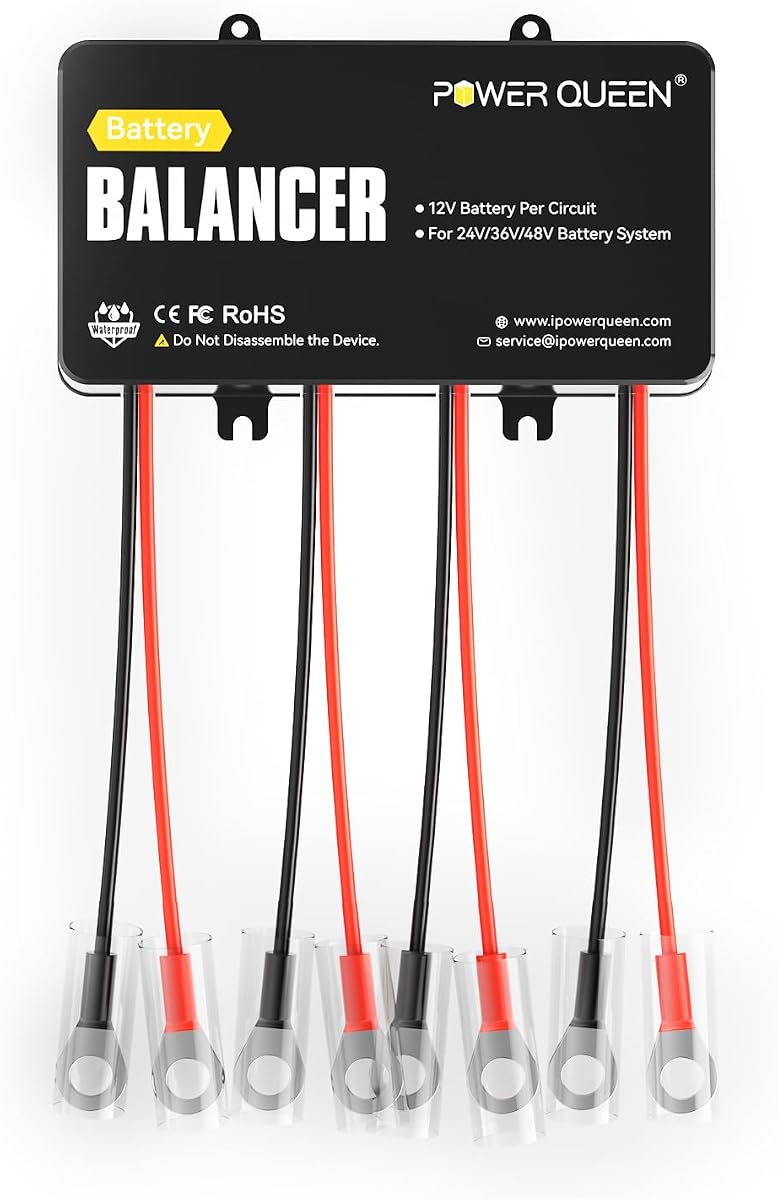
The Power Queen Battery Balancer 48V offers exceptional value for users seeking reliable voltage balancing without a premium price tag. It supports up to 48V battery banks with four connection ports, suitable for diverse applications like RVs and off-grid power systems. Its design focuses on practicality and essential safety features.
We may earn a commission when you buy through this link, at no additional cost to you.
It features intelligent auto-balancing technology that detects voltage differences exceeding 10mV and balances batteries until they are equal. Once balanced, it switches to a low-power standby mode drawing only 5mA, which conserves energy. This smart management helps extend the overall lifespan and cycle times of your battery system.
While cost-effective, users should note the specific connection requirement: connect in parallel first, then in series. This is standard for series-parallel systems but must be followed to ensure proper function. The balancing current is sufficient for most standard configurations but may be slower for very large banks.
This model is ideal for budget-conscious buyers who still need reliable performance for 24V to 48V systems. It balances essential features with affordability. If you want to extend battery life without overspending, this Power Queen balancer is a strong choice.
Switches to 5mA standby mode when balanced, conserving energy without compromising performance.
Supports LiFePO4, Lithium-ion, and Lead-Acid types including Gel, SLA, and FLA.
We may earn a commission when you buy through this link, at no additional cost to you.
The MAZAVA Battery Equalizer HX02 is a premium choice featuring an integrated LCD display for monitoring battery status. It supports 12V to 48V systems and offers active balancing capabilities with fast voltage difference detection. This model is designed for users who value precise monitoring and robust physical construction.
We may earn a commission when you buy through this link, at no additional cost to you.
Its aluminum alloy shell provides superior heat dissipation, which is crucial for maintaining performance in high-demand environments. The device supports multi-module parallel setups, allowing users to scale balancing for larger battery banks effectively. It detects voltage differences in thousandths, enabling rapid equalization.
While the price is higher than standard balancers, the build quality and monitoring features justify the cost for serious applications. Users might find limited availability compared to more common brands. The wide working voltage range ensures it works with various single battery types within 7-18V.
This balancer is best for professionals or enthusiasts who need detailed monitoring and scalable solutions. If you prioritize heat management and display data, this is a top-tier option. It offers advanced features that make managing complex battery banks easier.
Provides better heat dissipation to ensure stable performance in demanding conditions.
Allows multiple units to be connected in parallel for balancing larger voltage systems.
We may earn a commission when you buy through this link, at no additional cost to you.
This Battery Equalizer Voltage Balancer supports a remarkably wide range of battery configurations, from standard 12V up to 96V systems. It is suitable for lead-acid, lithium, and other chemistries. The rail-type buckle installation makes mounting in a distribution box easy and secure.
We may earn a commission when you buy through this link, at no additional cost to you.
The unit is designed to maintain charge and discharge balance between series or parallel connected batteries. It works effectively for single batteries in the 7V to 18V range. This flexibility allows users to connect multiple units for parallel or series setups to accommodate complex configurations.
While powerful, the design requires connecting multiple equalizers for larger systems. Users should ensure each unit corresponds to two batteries as instructed. Proper installation is critical for safety and performance in high-voltage setups.
This model is perfect for those needing to balance large, multi-voltage battery banks without complex setups. If you need a versatile solution for boats or industrial equipment, it offers broad compatibility. Just ensure you connect the right number of units for your system.
Simplifies installation in distribution boxes for secure and organized placement.
Can be scaled for systems up to 96V with multiple parallel connections.
We may earn a commission when you buy through this link, at no additional cost to you.
The 48V Battery Voltage Balancer comes with an LED display to help users visualize the balancing process. It connects four 12V batteries by default, suitable for systems requiring multiple parallel or series connections. It includes intelligent protection features like reverse polarity safeguards.
We may earn a commission when you buy through this link, at no additional cost to you.
Users can connect multiple units for higher voltages like 96V or more. The LED display provides useful visual feedback on the status of the system. This is helpful for quick checks without external tools. It is designed to maintain health and extend service life.
However, the product has a lower rating compared to competitors. Users may encounter setup complexities or limited documentation. For large systems, the need to link multiple units adds wiring complexity. It is a functional tool but may require careful assembly.
This model is suitable for users who want visual feedback and are comfortable with multi-unit configurations. If you need an affordable option for a 48V system, it offers basic features. Ensure you check instructions carefully for correct module connections.
Offers visual feedback on the balancing status of connected battery strings.
Allows connecting multiple equalizers to support higher voltage banks like 96V.
We may earn a commission when you buy through this link, at no additional cost to you.
The Redodo Battery Balancer 24V is designed for straightforward 2x12V setups. It features a high 10A equalization current that quickly reduces pressure differences between batteries. The LED display clearly shows voltage for the two connected strings, aiding in monitoring.
We may earn a commission when you buy through this link, at no additional cost to you.
It comes with M8 OT terminals and 50CM cables for easy direct use in series systems. The model includes dual automatic protections against reverse connection and high temperatures. This ensures safety and reliability for marine, RV, or off-grid applications.
While effective for 24V systems, it is not designed for higher voltages without additional units. Users needing larger banks may need to purchase more. However, the 1-year warranty and professional support provide added peace of mind for buyers.
This balancer is best for simple 24V applications needing fast and reliable balancing. If you need a direct-use solution with good warranty support, it is a solid option. Check that your system fits the two-string requirement.
Delivers up to 10A of equalization current to speed up voltage equalization.
Includes cables and terminals for easy installation without extra tools.
We may earn a commission when you buy through this link, at no additional cost to you.
This Power Queen Battery Equalizer focuses on intelligent auto-balancing technology. It activates automatically when voltage differences exceed 10mV, ensuring batteries stay balanced without manual intervention. Once balanced, it switches to a low-power standby mode to conserve energy.
We may earn a commission when you buy through this link, at no additional cost to you.
It supports 24V to 48V battery banks and is compatible with diverse battery types. The model includes reverse polarity and high-temperature protections to safeguard the system. This makes it a reliable solution for long-term use in RVs and off-grid setups.
While user-friendly, the connection order must be followed: parallel first, then series. Users should be mindful of this to avoid installation errors. The standby mode is a valuable feature for reducing unnecessary energy draw.
This model is ideal for users who want a set-and-forget solution for battery balance. If you need a reliable and energy-efficient balancer for 48V banks, it is a great choice. Follow the wiring instructions for optimal results.
Automatically detects and corrects voltage differences to maintain equal charge levels.
Switches to low standby mode to conserve energy once balanced.
We may earn a commission when you buy through this link, at no additional cost to you.
This Battery Equalizer 48V offers flexible usage for various battery configurations including 12V to 48V systems. It provides a 5A equalizer current and includes smart indicator lights for visibility of the working status. Users can connect multiple units in parallel for higher voltages.
We may earn a commission when you buy through this link, at no additional cost to you.
It supports a wide range of battery types such as Ni-Cd and Ni-MH. This broad compatibility makes it versatile for many applications. The unit includes reverse polarity protection and low-voltage cutoff to safeguard battery health.
For large banks, the 5A current may be slower than higher-capacity models. Users planning very large systems may need multiple units for effective balancing. The indicator lights help monitor operation easily without extra tools.
This model is suitable for users needing a flexible and compatible solution. If you have a mix of battery types, it offers broad support. Ensure you have enough units for your desired voltage scale.
Provides clear visibility of the balancer's working status for easy monitoring.
Supports various battery chemistries including Ni-Cd and Ni-MH.
We may earn a commission when you buy through this link, at no additional cost to you.
The HA01 Battery Equalizer features a digital LED display to help users check product voltage conveniently. It supports 24V to 48V systems with a 0-5A optimizing current. The flame retardant shell ensures safer installation in various environments.
We may earn a commission when you buy through this link, at no additional cost to you.
It balances battery voltage with a compensation current of 5A. The model has very low power consumption and reverse polarity protection. Users should follow the wiring instructions carefully to connect black and red wires correctly.
While the display is useful, the current capacity is limited to 5A. For large banks, this may be slower than high-capacity models. Proper wiring is critical to avoid damage or improper balancing.
This model is best for users who value digital display feedback and safety features. If you need a convenient tool for monitoring, it is a good choice. Ensure your system matches its current capabilities.
Convenient for users to check product voltage and monitoring status.
Flame retardant shell makes installation safer for various environments.
We may earn a commission when you buy through this link, at no additional cost to you.
The Victron Energy Battery Balancer focuses on improving the life of 24V battery banks by eliminating load imbalance. It equalizes the state of charge of two series connected 12-Volt batteries. When voltage exceeds 27-Volt, it draws up to 1Amp from the highest voltage battery.
We may earn a commission when you buy through this link, at no additional cost to you.
This current differential ensures all batteries converge to the same state of charge. Multiple balancers can be paralleled for larger setups. It is reliable for maintaining charge and extending overall service life of the system.
The lower balancing current of 1Amp may be slower for larger banks compared to 10A models. It is designed primarily for 24V systems. For 48V, you need multiple units which adds complexity.
This balancer is ideal for users managing 24V systems who prioritize life extension. If you have a specific 24V setup, it is a proven choice. For larger banks, consider a more powerful option.
Improves the life of your battery bank by balancing series connected batteries.
Several balancers can be paralleled to handle larger battery configurations.
We may earn a commission when you buy through this link, at no additional cost to you.
Selecting the right balancer involves considering your system voltage, battery types, and balancing needs.
Ensure the balancer supports your specific bank voltage. Many models handle 24V to 48V. Higher voltage needs require scalable solutions.
Check the single battery range and total system limits to avoid mismatched components.
Higher current models like 10A balance batteries faster. Lower current options like 1A or 5A are slower but often cheaper.
Choose based on your bank size and how quickly you need equalization to occur.
Not all balancers support every chemistry. Look for LiFePO4, Lead Acid, and SLA compatibility to ensure safety.
Verify the balancer is rated for your specific battery types to prevent damage.
Essential protections include reverse polarity and high-temperature safeguards. These prevent accidental damage and overheating.
Prioritize models with these safety upgrades for long-term reliability and peace of mind.
Active balancers move energy between cells to equalize charge. Passive ones often dissipate excess energy as heat.
Active technology is generally more efficient for extending battery cycle times and life.
Some units feature LED displays or smart indicators to show status. Others require external tools to monitor voltage.
If you prefer visual feedback, look for models with built-in displays for easier operation.
Consider the wiring complexity. Some require parallel then series connections. Others offer rail-type mounting for convenience.
Choose a model that fits your installation skill level and space constraints.
For large banks, check if multiple units can be paralleled. Some allow linking units for 96V systems.
Plan for future growth by selecting a balancer that supports expanding your battery capacity.
Begin by ensuring your battery bank is connected in the correct order. Most models require connecting in parallel first, then in series. Always double-check polarity to prevent reverse connection damage.
Once installed, the balancer will automatically start when it detects a voltage difference over 10mV. Monitor the indicator lights or display to confirm balancing activity. Leave it connected long-term for continuous balance maintenance.
Regularly check for overheating signs and ensure the unit has airflow. Clean the terminals and connections periodically to avoid corrosion. Follow manufacturer instructions for firmware updates if applicable to keep performance optimal.
A battery equilizer balancer ensures that all batteries in a series or parallel bank maintain the same charge level. It prevents individual batteries from overcharging or undercharging, which extends the overall lifespan of the battery system. It activates when voltage differences exceed a threshold and balances them automatically.
Yes, balancers are recommended for lithium batteries to ensure safe operation. They help manage cell-to-cell variance which can prevent thermal runaway or reduced capacity. However, ensure the balancer is explicitly compatible with your specific lithium chemistry like LiFePO4.
Many models designed for 48V banks include four connection ports to handle the full system. If your model only supports lower voltages, you may need multiple units connected in parallel to balance a 48V bank effectively. Check the product specifications for capacity limits.
Active balancing moves energy from higher charged cells to lower ones using a circuit. Passive balancing usually dissipates excess energy as heat. Active methods are more efficient and better for extending battery life, while passive methods are simpler.
It is generally not recommended to mix different battery chemistries or ages. A balancer works best with batteries of the same type and age to ensure even balance. Mixing types can lead to uneven charging and potential safety risks.
Most modern balancers enter a low-power standby mode when balanced. They may draw less than 5mA to conserve energy. This minimal draw ensures they do not significantly drain your battery bank during periods of inactivity.
Yes, it is safe to leave them connected for long-term monitoring and balancing. Most models are designed to operate continuously without overheating. Always ensure the unit has proper airflow and is installed in a protected environment.
Check the indicator lights or LED display to see if balancing is active. You may also measure battery voltages with a multimeter to confirm they converge. A working balancer will reduce voltage differences over time until they are below 10mV.
Choosing the right balancer depends on your specific system voltage and battery types. The LiTime and Power Queen models offer strong all-rounders with active balancing. The MAZAVA provides premium features for those needing advanced monitoring.
Prioritize safety features like reverse polarity and temperature protection for reliability. Consider the balancing current to ensure it meets the needs of your battery bank size. A well-chosen balancer significantly extends cycle times and overall battery health.
Always verify current prices and availability before purchasing as they fluctuate. Check product reviews and warranty options for peace of mind. Invest in a quality solution that matches your setup for the best long-term performance.