
VunLink 10GbE RJ45 Ethernet Card
4.3Editor score
Realtek RTL8127 Chipset
PCIe 4.0 x1 Interface
Windows Linux Compatible
This guide compares the top 10GbE Network Card for PC options available in 2026 to help you choose the best high-speed adapter for your desktop.
Finding a reliable 10GbE Network Card for PC is essential for users needing faster data transfers and improved network performance in modern computing environments.
We evaluated ten top-rated adapters based on chipset quality, compatibility, build quality, and real-world performance metrics to create this comprehensive comparison list.
Each pick highlights key strengths and trade-offs to help you decide quickly though keep in mind that product availability and pricing may change over time.
4.3Editor score

4.2Editor score

4.4Editor score
This side-by-side comparison highlights the key specifications and features of each adapter to help you make an informed decision based on your specific needs.


The TP-Link TX401 stands out as a top choice for users seeking a straightforward upgrade to 10GbE networking without breaking the bank. It delivers reliable speeds up to 10Gbps and includes everything you need to get started right out of the box. Its reputation for stability and ease of setup makes it a favorite among home and small office users.
We may earn a commission when you buy through this link, at no additional cost to you.
This adapter uses the latest 10GBase-T technology to ensure backward compatibility with existing network infrastructure. It automatically negotiates speeds between 10Gbps down to 100Mbps depending on your switch or router capabilities. The included CAT6A cable ensures you can hit maximum speeds without needing extra purchases. Quality of Service features also help prioritize gaming traffic during heavy network use.
While performance is solid, some users report occasional driver glitches depending on their specific operating system version. It also runs slightly warmer than expected under load, though this rarely impacts stability. These issues are minor compared to the benefits of having a plug-and-play solution that works well with most Windows and Linux distributions.
If you want a reliable upgrade for file transfers or media streaming without deep technical requirements, this card is an excellent choice. It balances price, performance, and compatibility better than most competitors in its class. Just ensure your power supply and case have enough clearance for the standard bracket before purchasing.
Backward compatibility ensures you can upgrade your PC without replacing your entire network infrastructure or buying new switches.
The included CAT6A cable saves time and money while guaranteeing the cabling meets the speed requirements for 10Gbps performance.
We may earn a commission when you buy through this link, at no additional cost to you.
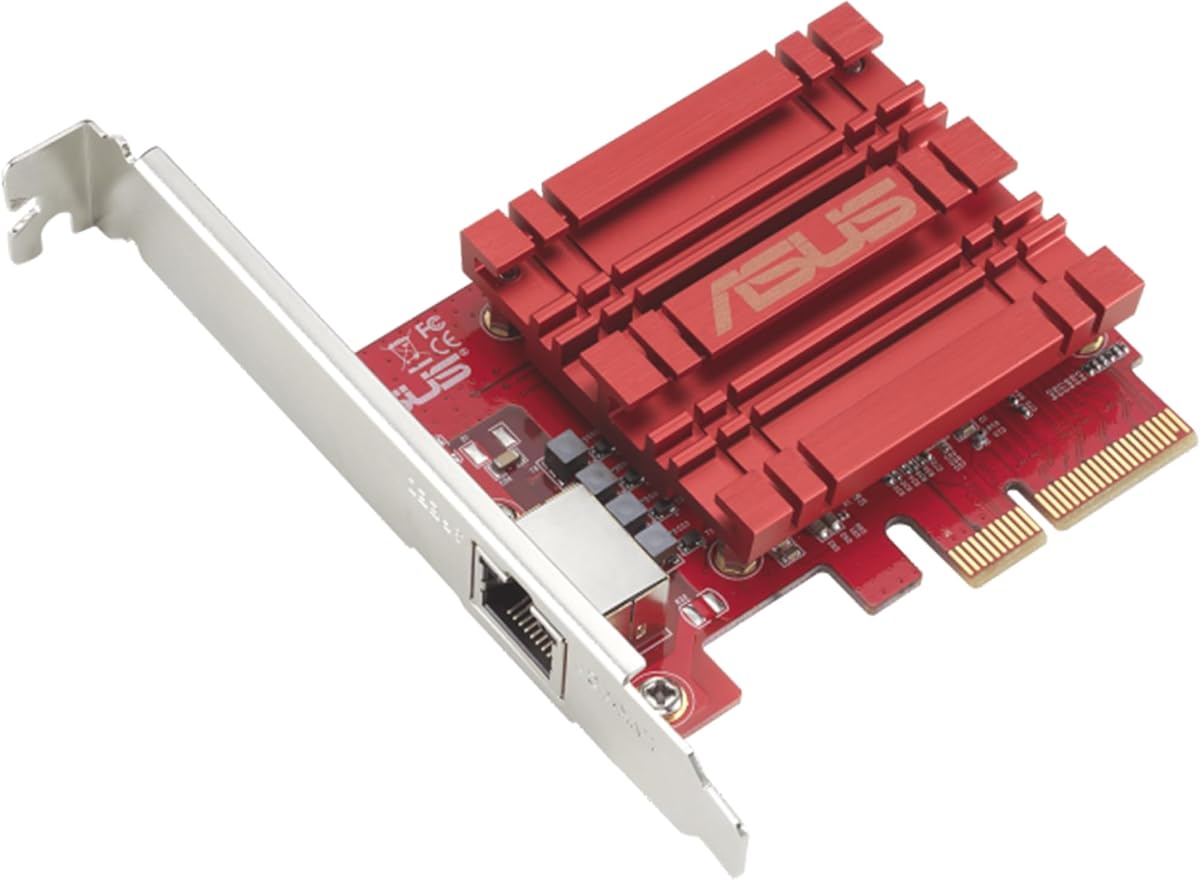
The Asus NADACA0140 delivers Hyper-fast 10Gbps networking suitable for bandwidth-demanding tasks like large file transfers and cloud backups. It integrates well with both Windows and Linux systems, making it a flexible choice for diverse computing environments. Its build quality reflects the brand's reputation for durability and reliable performance in home and office setups.
We may earn a commission when you buy through this link, at no additional cost to you.
With full compatibility across common network standards, this card negotiates seamlessly with your existing hardware. It includes built-in Quality-of-Service technology to prioritize critical data packets for smoother online experiences. While it lacks some advanced server features, it covers all essentials for desktop upgrades efficiently. The RJ45 port works with standard copper cables for easy cabling.
One downside is the lack of an included Ethernet cable, which means an extra purchase if your current cabling doesn't support 10Gbps speeds. Additionally, it has fewer advanced features compared to dual-port or enterprise-grade adapters. However, for single-user PCs, it remains a solid, no-fuss option for modern networking needs.
This adapter is best suited for users who prioritize compatibility and straightforward performance over advanced virtualization features. It performs well in gaming and media applications where low latency and consistent speeds matter most. Keep your existing cables in mind when planning your upgrade to avoid connectivity bottlenecks.
Quality-of-Service helps ensure gaming traffic gets priority, reducing lag even when other devices are downloading large files.
Support for multiple Linux kernels ensures this card works in many open-source environments without requiring custom drivers.
We may earn a commission when you buy through this link, at no additional cost to you.
The Vogzone X550-T2 offers dual RJ45 ports and an original Intel X550AT2 controller tailored for server-grade reliability and virtualization. It supports single-root I/O virtualization and includes advanced traffic management features for high-demand environments. This makes it ideal for home labs, virtualization setups, and small business servers needing redundant network links.
We may earn a commission when you buy through this link, at no additional cost to you.
Its PCIe 3.0 x4 interface provides ample bandwidth for full 10Gbps performance on both ports simultaneously. The card supports on-chip QoS, load balancing, and checksum offloading to reduce CPU overhead during heavy data transfer tasks. Firmware updates can be done remotely without rebooting, minimizing downtime in production environments. It also supports major OSes including Windows Server and VMware ESXi.
However, this adapter requires more technical knowledge to configure properly, especially when negotiating multi-gig speeds manually. It consumes more power than single-port consumer cards and may run hotter. Not everyone needs dual ports, so ensure your switch supports the required configurations before investing in this higher-end option.
Choose this card if you need redundancy, load balancing, or advanced virtualization features that standard consumer cards lack. It provides professional-grade tools in a form factor accessible to advanced users. For basic home internet upgrades, a simpler single-port card may suffice at a lower cost.
SR-IOV and VMDq features allow multiple virtual machines to share the physical NIC efficiently without performance loss.
NVM update utility lets you refresh firmware without entering BIOS, saving time for network administrators managing multiple devices.
We may earn a commission when you buy through this link, at no additional cost to you.
Powered by the Realtek RTL8127 chipset, this VunLink adapter delivers up to 10Gbps connectivity at an accessible price point for most users. It supports auto-negotiation from 10Gbps down to 100Mbps, making it versatile across various network setups. Designed with efficiency in mind, it consumes less power and generates less heat than many competing 10GbE solutions.
We may earn a commission when you buy through this link, at no additional cost to you.
The PCIe 4.0 x1 interface ensures you can use smaller slots on your motherboard without sacrificing performance, freeing up slots for other add-ons. It includes both standard and low-profile brackets for flexible installation in various case sizes. Compatibility covers Windows 10/11 and mainstream Linux distributions, though driver installation might be needed depending on your OS version.
Users may find that driver support isn't as polished as major brands, which could require troubleshooting on some Linux systems. It also lacks some enterprise features like advanced offloading that professionals might need. For home users and small NAS setups, however, these trade-offs are often acceptable given the lower cost and good real-world performance.
This is the top pick for budget-conscious buyers who want solid 10G performance without overspending on enterprise features. It is ideal for upgrading home labs, media PCs, or small offices where simplicity matters most. Just be prepared to download drivers and verify compatibility with your specific operating system.
Using a PCIe x1 slot saves valuable expansion space while still delivering full 10Gbps networking performance.
Lower power consumption means less heat generation and quieter operation, ideal for compact home theater PCs.
We may earn a commission when you buy through this link, at no additional cost to you.
The Intel X540T2 is a proven dual-port 10Gbase-T adapter known for reliability and low power usage across data center and home lab environments. It provides a single-chip solution that integrates Mac and Phy for stable performance under demanding conditions. This card has been trusted for years and remains a popular choice for those needing two 10G connections without expensive SFP+ hardware.
We may earn a commission when you buy through this link, at no additional cost to you.
Its support for virtualization and port partitioning allows users to create up to 64 virtual ports for flexible network segmentation. It works seamlessly with standard CAT-6a cabling and RJ45 connectors, simplifying cabling upgrades. Backward compatibility with existing 1000Base-T networks ensures smooth transitions without replacing switches immediately.
While reliable, it uses older architecture compared to newer X550 series cards, which may limit certain advanced features or power efficiency. Driver support may not be as actively updated as newer models, requiring checks for compatibility with very recent OS versions. However, its proven track record makes it a safe bet for stability-focused users.
Invest in this card if you need dual 10G connections with trusted Intel hardware and value long-term stability over the latest features. It is excellent for NAS builds, virtualized home labs, or small offices needing redundant links. Ensure your PCIe slot has adequate space for the dual-port design before purchasing.
Virtual port creation enables network segregation without buying multiple physical NICs, saving PCIe slots and cost.
Standard CAT-6a support means you can upgrade without replacing switches, using familiar RJ45 connectors.
We may earn a commission when you buy through this link, at no additional cost to you.
TRENDnet's TEG-10GECTX is built for environments requiring NDAA and TAA compliance, making it suitable for government and regulated sectors. It delivers reliable 10Gbps performance with support for 2.5G BASE-T speeds over existing cabling, providing flexibility. The adapter includes both standard and low-profile brackets, ensuring it fits in most desktop and server cases.
We may earn a commission when you buy through this link, at no additional cost to you.
Backed by a three-year manufacturer protection plan and responsive English-speaking technical support, this card offers peace of mind for critical setups. It supports various Windows and Windows Server versions, covering most enterprise and small business needs. LED indicators help troubleshoot connectivity issues quickly without digging into logs or software.
The compliance features may come at a higher cost than consumer-grade cards, which may not be justified for home users. Its operating system support focuses on Windows and Server, potentially limiting use in non-standard Linux environments. Still, for secure deployments, these restrictions align with compliance and operational requirements.
Choose this adapter if compliance, warranty length, and vendor support are priorities alongside 10G performance. It suits office deployments where long-term stability and official backing matter. Verify your OS compatibility early to avoid surprises with driver availability on non-standard platforms.
NDAA and TAA compliance ensures your network hardware meets strict government procurement requirements for security and sourcing.
Three years of protection and accessible support reduce risk for businesses relying on stable network infrastructure.
We may earn a commission when you buy through this link, at no additional cost to you.
The YuanLey 10G network card uses the Realtek RTL8127AT controller to deliver stable high-speed networking with hardware checksum offload and Wake-on-LAN support. It is designed to be compatible with a wide range of PCIe slots from x1 to x16, making it versatile for different motherboard designs. Its low-latency performance benefits gaming PCs and home labs needing quick access.
We may earn a commission when you buy through this link, at no additional cost to you.
It supports Cat5e through Cat7 cables for transmission distances up to 100 meters, offering flexibility if you want to reuse existing cabling. Both low-profile and full-height brackets are included for installation flexibility. The company provides lifetime technical support, which can be helpful if you encounter setup issues or need guidance.
While performance is strong, the brand is less recognized than major manufacturers, which may affect long-term driver availability. Users might need to rely on community forums or official channels for niche OS versions. The value proposition remains high for users prioritizing WOL and flexible cabling without paying for unnecessary enterprise features.
This card is ideal for gamers and power users who want Wake-on-LAN functionality and reliable 10G performance. It suits home theater PCs and small offices where cost and performance balance matters most. Ensure your power settings allow WOL to function correctly after installation.
Remote wake-up lets you turn on your PC from another device, handy for home servers and media streaming.
Support for older cable types reduces upgrade costs by letting you keep existing network wiring for short runs.
We may earn a commission when you buy through this link, at no additional cost to you.
The TP-Link TX201 delivers 2.5Gbps speeds ideal for users whose networks or switches only support Multi-Gig but not full 10G. It is fully backward compatible with 1Gbps and 100Mbps connections, ensuring it works with existing infrastructure. Its high rating reflects reliability and ease of use across various operating systems including Windows Server and Linux.
We may earn a commission when you buy through this link, at no additional cost to you.
Quality of Service helps prioritize gaming and video traffic to avoid congestion during heavy downloads. Wake-on-LAN support lets you remotely manage your PC power states. It includes low-profile and full-height brackets for flexible installs in mini-towers and standard desktops. Two-year warranty with free 24/7 technical support adds confidence.
While it won't hit 10Gbps, it offers a cost-effective path for users not yet ready for 10G infrastructure. If your router or switch only supports 2.5G, this adapter makes sense without overbuying. For those needing max speed, you would need a full 10G card instead, so plan accordingly.
Buy this if you have a 2.5G network and want reliable performance without the cost of 10G gear. It suits home labs and small offices upgrading gradually. Check your network equipment capabilities to ensure you get the speed you expect.
This card eases migration from Gigabit networks by supporting 2.5G speeds without requiring a full infrastructure overhaul.
QoS ensures streaming and gaming stay smooth even when other devices are uploading large files to the network.
We may earn a commission when you buy through this link, at no additional cost to you.
The WAVLINK 10G adapter features robust metal shielding to minimize electromagnetic interference and enhance stability in noisy environments. Its heat dissipation design keeps temperatures low for stable transmission. It works with Windows 11/10 and Linux, ensuring broad OS support. It includes low-profile and standard brackets for versatile mounting options.
We may earn a commission when you buy through this link, at no additional cost to you.
The card accommodates various PCIe slot types, including x1, x4, x8, and x16, allowing flexible hardware layouts. A note advises downloading the latest driver from the official site and warns antivirus software may flag it due to signature recognition. Removing the plastic film from the PCIe interface before installation is also recommended for best contact.
Users may encounter minor setup quirks with driver installation or interference issues if not properly shielded. Still, its focus on reliability and heat management makes it a solid pick for compact builds and home servers. Its balanced price and feature set suit general consumers needing 10G without enterprise complexity.
This adapter is best for users prioritizing signal integrity and thermal management in small form factor builds. It delivers consistent speeds without overheating. Follow the driver and installation tips to avoid common setup issues and ensure stable performance.
Metal shielding reduces interference from nearby electronics, ensuring stable data transfer in crowded environments.
Effective heat dissipation prevents throttling, keeping speeds consistent even during prolonged large file transfers.
We may earn a commission when you buy through this link, at no additional cost to you.
The NICGIGA 10G adapter uses the Intel X540-T1 controller to provide extreme speeds and prevent packet loss in data transmission. It supports 10GBASE-T, 1000BASE-T, and 100BASE-TX applications, ensuring broad compatibility. With standard and slim brackets included, it fits in various desktop and server setups. Lifetime technical support offers long-term reassurance.
We may earn a commission when you buy through this link, at no additional cost to you.
Its support for VMware, ESX, and Linux makes it suitable for virtualization environments and home labs. The Intel controller ensures reliability and performance consistent with Intel's reputation. Heat dissipation design keeps temperatures down for stable operation. However, it only provides a single RJ45 port, which may limit redundancy.
Since it uses older X540 architecture, it may not support some newer virtualization features found in X550 series. Still, it remains a strong budget option for single-port needs with enterprise-grade chip reliability. Verify your switch supports 10GBase-T before relying on it for high-speed connections.
Choose this card if you want Intel reliability in a single-port package for virtualization or home use. It balances cost with proven performance. Check compatibility with your latest OS and virtualization platform to ensure smooth operation.
Broad support for VMware and ESX makes this card ideal for virtualized environments needing reliable networking.
Single port design reduces cost and slot usage for users needing straightforward upgrades without redundancy.
We may earn a commission when you buy through this link, at no additional cost to you.
Selecting the right 10GbE Network Card for PC depends on your network needs, budget, and system compatibility. This guide covers key factors to consider.
The chipset determines performance and compatibility. Realtek and Intel controllers are common; Intel offers enterprise features while Realtek suits budget builds. Choose based on your workload and OS needs.
Look for cards with proven controllers like Intel X540 or X550 or Realtek RTL8127 for reliable performance and driver support.
Most 10GbE cards require PCIe x4 slots but some fit x1. Check your motherboard slots and lane configuration to avoid bandwidth bottlenecks.
Confirm your PC has available PCIe x4 or x1 slots compatible with the card's interface type before purchasing.
Drivers vary by OS; Windows has broader support while Linux depends on kernel version. Ensure your OS is listed by the vendor to avoid setup issues.
Check vendor documentation for your specific OS version to confirm driver availability before buying.
Your router or switch must support 10Gbps or Multi-Gig speeds. Check your existing equipment to avoid mismatched capabilities.
Verify that your network gear supports the speeds the card offers for full performance.
10GBase-T requires Cat6a cables for best performance; Cat6 might work over short distances. Ensure your cables match the card's speed needs.
Use Cat6a cabling to guarantee stable 10Gbps connections without signal degradation.
Virtualized environments benefit from SR-IOV and load balancing features found on enterprise cards. Home users may not need these.
If you run VMs, choose cards with SR-IOV and virtualization support for best performance.
Some cases need low-profile brackets. Check your case clearance and bracket inclusion to ensure physical fit.
Confirm brackets match your case size, especially for small form factor builds.
Good warranty and support reduce risk. Brands offering lifetime or multi-year support help troubleshoot issues later.
Choose vendors with responsive technical support and solid warranty coverage for peace of mind.
Begin by downloading the latest drivers from the vendor's website before installing the card to avoid OS conflicts.
Install the card securely in a compatible PCIe slot, ensuring brackets are fitted properly and cables are connected firmly.
After installation, configure your network settings and test connection speeds to confirm full performance and troubleshoot any issues.
Yes, for full 10G speeds you should use Cat6a cables, though Cat6 might work over short distances. Using the right cable ensures stable performance and avoids bottlenecks in your network setup.
Yes, these cards negotiate down to supported speeds automatically. Your connection will run at 1Gbps if your switch only supports that speed.
Most cards support mainstream Linux distributions with drivers available for various kernels. Always check vendor compatibility lists before buying.
It reduces latency for fast local network access but doesn't directly improve internet gaming. QoS features can help prioritize game traffic though.
Typically no, but updating firmware may resolve compatibility. Follow vendor instructions if issues arise after installing the card.
10GBase-T uses copper RJ45 ports while SFP+ uses fiber or DAC cables. Copper is easier for typical upgrades but SFP+ offers lower power.
We covered ten top 10GbE Network Card for PC options ranging from budget-friendly Realtek cards to reliable Intel enterprise solutions.
Prioritize your network infrastructure and OS needs when selecting a card to ensure smooth performance and avoid compatibility issues.
Always check current availability and pricing before buying since these can change frequently depending on market conditions.