
FLY RC Cellmeter 7
4.6Editor score
Compact and lightweight design
Supports 2 to 7 cell packs
Displays total and individual voltages
This guide compares the top ten Li Ion Battery Tester models for accuracy, features, and value to help you choose the right tool for your needs.
Choosing the right Li Ion Battery Tester is crucial for maintaining the health and safety of your rechargeable devices. Whether you manage RC drones, flashlights, or power banks, accurate testing prevents over-discharge and ensures optimal performance.
We evaluated ten leading testers based on compatibility, accuracy, display clarity, and ease of use. Our comparison covers everything from budget-friendly single-cell checkers to advanced multi-channel analyzers suitable for professionals.
Each selection highlights key strengths and potential limitations to guide your decision. Prices and availability change frequently, so verify current details before purchasing to ensure you get the best value for your specific application.
4.6Editor score

4.7Editor score

4.5Editor score
The following table provides a side-by-side comparison of all ten selected testers. Review the specifications to identify which model aligns best with your battery types and testing requirements.




This module offers a comprehensive solution for testing 18650 batteries with features like capacity and internal resistance measurement. Its four-channel capability allows users to check multiple cells at once, improving workflow efficiency for larger batches.
We may earn a commission when you buy through this link, at no additional cost to you.
The digital display provides immediate access to critical data points including voltage, current, and power. This information is essential for assessing battery health and ensuring safe operation in devices like flashlights or portable power stations.
While the device is feature-rich, users should note that the manual is not included in the box and must be requested from the seller. Additionally, the measurement error is estimated around 10%, which may not suit precision laboratory work.
This tester is ideal for hobbyists and casual users who need to verify battery capacity without expensive equipment. It simplifies the process of identifying weak cells before they fail in critical applications.
The device combines charging and discharging functions to save time and reduce handling of battery cells during testing.
Users can monitor live readings for voltage, current, and power to ensure accurate capacity analysis during operation.
We may earn a commission when you buy through this link, at no additional cost to you.
Designed for general household use, this tester supports a wide range of battery types including alkaline, lithium, and Ni-MH. The digital interface clearly indicates whether a battery is good, weak, or poor.
We may earn a commission when you buy through this link, at no additional cost to you.
The magnetic slot design ensures that batteries stay in place during testing, making it easy to use with one hand. This feature is particularly helpful when testing larger cells like C or D sizes that might otherwise roll away.
Although the device is rechargeable and lasts up to 15 hours, it does not come with a power adapter, requiring a separate USB charger. It is also limited to standard household cells rather than specialized RC packs.
This unit is perfect for keeping in a drawer or workshop to quickly check spare batteries. It eliminates guesswork and helps prevent device failure due to depleted power sources.
The magnetic slider holds batteries firmly in place during testing to prevent slipping and ensure consistent contact.
With USB-C rechargeability, the device operates for up to 15 hours on a single charge for extended use.
We may earn a commission when you buy through this link, at no additional cost to you.
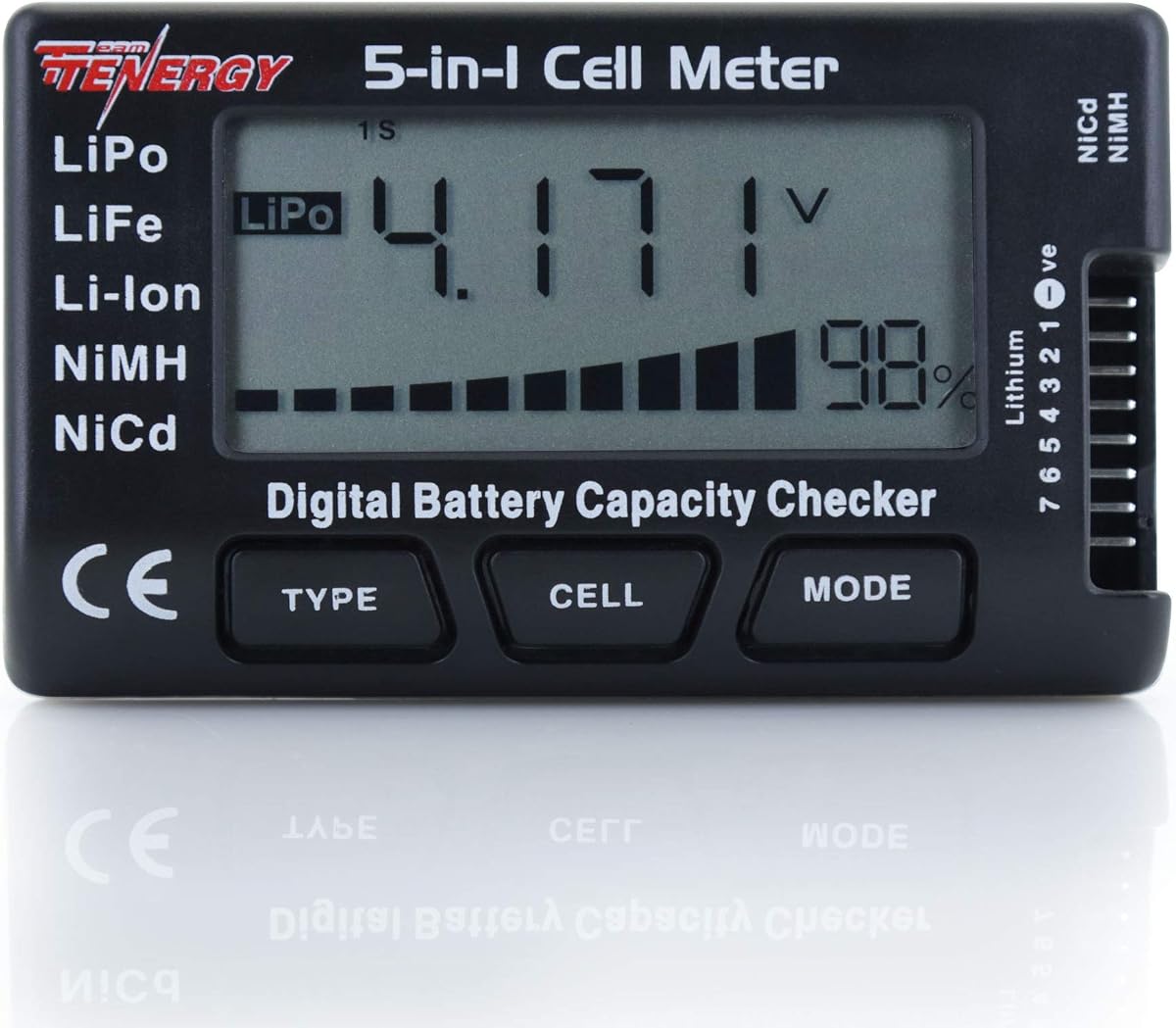
This meter is a straightforward tool for checking voltage and capacity across various battery chemistries used in RC hobbies. It supports LiPo, Li-ion, NiMH, and Nicd packs, making it versatile for multiple vehicle types.
We may earn a commission when you buy through this link, at no additional cost to you.
The large LCD screen makes it easy to read voltage values even in outdoor conditions. The one-click measurement button simplifies the process, allowing users to get readings quickly without navigating complex menus.
While it offers essential testing functions, it lacks advanced features like internal resistance measurement or balancing capabilities. It serves best as a basic check for voltage health rather than a comprehensive diagnostic tool.
RC hobbyists looking for an affordable way to monitor battery health will find this device useful. It is compact enough to carry in a flight bag for quick checks before flying.
The device features a one-click button to start measurements quickly without complex setup or navigation.
It supports LiPo, Li-ion, NiMH, and Nicd batteries to accommodate various RC applications and devices.
We may earn a commission when you buy through this link, at no additional cost to you.
This intelligent meter does more than just display voltage; it functions as a balancer and discharger for lithium and NiMH packs. This multi-purpose design helps optimize battery performance and extend overall lifespan.
We may earn a commission when you buy through this link, at no additional cost to you.
The device draws power directly from the battery pack being tested, eliminating the need for a separate power adapter. It can discharge packs at 180mA to a set threshold, which is useful for storage preparation.
While it offers balancing features, the discharge rate is relatively slow compared to dedicated dischargers. It also relies on specific connectors like Hitech or Futaba for NiMH packs.
RC users who need a compact tool to balance cells before or after charging will appreciate this device. It helps ensure that individual cells are evenly charged to prevent cell degradation.
The meter helps optimize battery performance by ensuring individual cells remain balanced during testing cycles.
It operates using the energy from the battery pack being tested, making it completely self-powered and portable.
We may earn a commission when you buy through this link, at no additional cost to you.
Offering a high-quality experience at an entry-level price, this cellmeter is perfect for beginners or those needing a simple check. It is lightweight and durable, designed to withstand regular use in a field environment.
We may earn a commission when you buy through this link, at no additional cost to you.
The display mode includes total voltage, individual cell voltages, and the voltage gap between the highest and lowest cells. This gap information is critical for identifying unbalanced cells that could fail during use.
While it does not offer advanced features like resistance measurement or balancing, it fulfills its primary role effectively. The compact design allows it to be carried easily in a toolbox or flight bag.
This meter is an excellent choice for casual RC users who need reliable voltage readings without breaking the bank. It provides essential data to ensure batteries are safe to use.
Displays the voltage difference between cells to help identify imbalance issues before they cause failure.
Its lightweight and compact build ensures it is easy to transport and use in any environment.
We may earn a commission when you buy through this link, at no additional cost to you.
This advanced checker utilizes BattGO technology to provide detailed insights when connected to compatible battery packs. It monitors parameters such as cell voltage, battery cycles, and working settings for informed management.
We may earn a commission when you buy through this link, at no additional cost to you.
The device features an auto-balancing algorithm that ensures every cell is balanced, which is vital for extending battery lifespan. After balancing, it enters a low power mode to save energy.
It also serves as a power bank for mobile devices, supporting Qualcomm QC 2.0 and 3.0 standards. However, full functionality requires specific connectors like XT60i, which may not be included with every purchase.
RC hobbyists seeking deeper insights into battery health will appreciate the detailed data provided. It combines testing with balancing and power delivery in a single versatile unit.
Works with BattGO to provide detailed cell and cycle data for smarter battery management.
Supports QC 2.0 and 3.0 standards to charge mobile devices while testing batteries.
We may earn a commission when you buy through this link, at no additional cost to you.
This version of the BG-8S adds receiver signal testing and protocol analysis capabilities. It supports PWM, PPM, and S.BUS, making it a valuable diagnostic tool for RC vehicles beyond just battery testing.
We may earn a commission when you buy through this link, at no additional cost to you.
Like its counterpart, it uses auto-balancing to maintain cell health and includes a powerful output up to 12V 2A for charging devices. The LCD display is clear and easy to read in various lighting conditions.
While it offers advanced features, users may need to update firmware to access full protocol support. It is also best suited for users familiar with RC electronics due to its multifaceted functionality.
Enthusiasts who want a single tool for checking receiver signals and battery health will find this unit exceptional. It bridges the gap between a simple voltage checker and a professional diagnostic device.
Supports multi-protocol analysis including PWM, PPM, and S.BUS for comprehensive RC system checks.
Detects BEC output voltage and supports standard 3-pin connectors for receiver signal verification.
We may earn a commission when you buy through this link, at no additional cost to you.
This tester is designed for users who need to evaluate large batches of 18650 batteries efficiently. Its eight independent channels allow for simultaneous testing without interference between channels.
We may earn a commission when you buy through this link, at no additional cost to you.
The device features a 2.4-inch color screen that provides real-time visualization of charge and discharge cycles. It also includes reverse connection protection to prevent damage to batteries or the tester itself.
While the price is higher than basic testers, the throughput efficiency justifies the cost for professionals or serious hobbyists. It supports automatic model detection to streamline the setup process.
This unit is ideal for refurbishing laptops or building power banks where consistent battery performance is required. It offers a level of control and safety that simpler testers lack.
Allows for simultaneous testing of up to eight batteries to improve workflow efficiency.
Features a color screen to display live charge and discharge cycle progress for better monitoring.
We may earn a commission when you buy through this link, at no additional cost to you.
This compact checker is designed for quick and easy field checks on drones and RC vehicles. It shows total voltage and per-cell voltage, allowing users to assess battery health at a glance.
We may earn a commission when you buy through this link, at no additional cost to you.
The digital screen is easy to read, providing instant feedback on cell conditions. It supports a wide range of chemistries including LiPo, Li-ion, and NiMH in 2 to 7S configurations.
It is limited to balance connectors, meaning it cannot test single cells or standard packs without adapters. It also does not offer charging capabilities, focusing purely on voltage reading.
RC pilots and car enthusiasts will find this device convenient for daily checks. It is lightweight and small enough to keep in a flight case without adding bulk.
Provides immediate total and per-cell voltage readings on a clear digital screen.
Lightweight and compact design ensures it is easy to pack and carry for field use.
We may earn a commission when you buy through this link, at no additional cost to you.
This tester uses patented Pulse Load Technology to measure battery capacity under load, offering higher accuracy than simple voltage readings. It is designed to identify weak or failing batteries across all common household sizes.
We may earn a commission when you buy through this link, at no additional cost to you.
The device is fully automatic, requiring no switches or settings. It performs a two-second test that accurately identifies the remaining percentage of battery capacity, helping users decide whether to reuse or recycle.
It is compact with a lead storage mechanism built into the seam, making it easy to travel with. It is made in the United States and includes a one-year warranty for added confidence.
This unit is the best choice for users who need precise data on battery health without complex procedures. It helps save money by extending the life of usable batteries.
Uses patented pulse load technology to measure capacity under load more accurately than simple voltage checks.
Requires no switches or settings, performing a fully automatic two-second test for immediate results.
We may earn a commission when you buy through this link, at no additional cost to you.
Selecting the right tester depends on your specific needs, such as battery type, volume of testing, and desired accuracy. This guide outlines key factors to consider.
Ensure the tester supports the specific chemistry and size of batteries you use. Some devices are designed for household AA/AAA cells, while others specialize in RC packs like LiPo or Li-ion.
Check the product specifications to confirm voltage ranges and connector types match your collection before purchasing.
For professional use or safety-critical applications, look for testers with higher accuracy ratings and internal resistance measurement. Budget models may have higher error margins suitable only for rough checks.
Consider Pulse Load Technology if you need true capacity readings rather than just open-circuit voltage.
A clear display is essential for reading data quickly. LCD screens vary in size and clarity, so opt for one that is easy to read in your typical lighting conditions.
Digital displays are generally preferable to analog needles for precision and ease of interpretation.
If you plan to take the tester to the field, prioritize compact and lightweight designs. Larger multi-channel testers are better suited for stationary workshops.
Look for built-in storage for probes or cables to keep everything organized in your travel kit.
Some testers offer extra functionalities like balancing, discharging, or acting as a power bank. Evaluate if these features add value to your workflow.
Avoid paying for advanced features you will not use if a basic voltage checker meets your needs.
Consider how intuitive the interface is. Devices that require complex setup or external power sources may slow down your workflow.
Look for features like auto-detection or simple button interfaces for faster testing.
A robust build quality ensures the tester withstands drops and rough handling common in workshops or field use.
Check for protective features like reverse connection protection to prevent damage to the device or batteries.
A good warranty indicates manufacturer confidence and provides peace of mind. Look for options with at least a one-year coverage.
Verify that customer support is accessible in case you need manuals or replacements.
Always insert batteries with the correct polarity to avoid damage. Check the markings on the tester and match them to the positive and negative ends of the battery.
For accurate results, test batteries at room temperature. Extreme cold or heat can affect voltage readings and lead to incorrect assessments.
Clean the probe contacts regularly to ensure good connection. Store the device in a dry place to protect the electronics from moisture.
Voltage testing measures the potential difference at a specific moment, while capacity testing measures how much energy the battery can store. Load testers provide more accurate capacity data than simple voltage checks.
Not all Li Ion testers work with alkalines. Ensure the device specifies compatibility with alkaline or Ni-MH chemistries. Some models are restricted to lithium-based batteries only.
Many handheld testers operate using the battery being tested, so no external power is needed. However, advanced multi-channel units may require a USB or AC adapter to function.
Test batteries regularly, especially after storage or if performance drops. Frequent checks help identify weak cells before they fail completely during use.
Internal resistance indicates the health of a cell. High resistance often means the battery is degraded and may not deliver sufficient current even if voltage is normal.
No, do not mix battery types in a single tester unless it explicitly supports all of them. Mixing chemistries can lead to inaccurate readings or damage to the device.
Our top picks cover a range of needs from budget-friendly household checkers to advanced professional analyzers. Whether you need a simple voltage checker or a multi-channel system, there is an option available.
Prioritize accuracy and compatibility based on the batteries you use most. Advanced features like balancing are valuable for RC hobbyists but may be unnecessary for casual users.
Prices and availability change frequently, so always verify the latest details before purchasing. Choose a model that balances cost with the features you truly need.