
Yxk Zero1 2-Bay Desktop NAS for Home & Personal Storage(Diskless)
4.4Editor score
2.5GbE network connectivity
Supports Docker containers
Compact lightweight design
Discover the top diskless NAS enclosures for home and office storage. This guide compares ten models for performance, capacity, and features.
Finding the right diskless NAS enclosure transforms how you manage digital files at home or work. These devices let you choose your own drives for flexibility and control without locking you into pre-set storage limits or expensive subscription fees.
We evaluated ten leading models based on speed, expandability, software support, and reliability. Our comparison includes budget-friendly options for personal use and powerful systems designed for creators, small businesses, and technical enthusiasts who demand robust performance.
Each pick shows key strengths, limitations, and ideal use cases to help you decide. Prices and availability change frequently, so always check current listings before purchasing. This guide focuses on diskless units where you supply the hard drives or SSDs.
4.4Editor score

4.6Editor score

4.6Editor score
The following table presents a side-by-side overview of the ten top diskless NAS enclosures evaluated in this guide. Each entry highlights key specifications and capabilities to help you compare options quickly and identify the model that matches your storage requirements and budget.




The Synology DS223j stands as the top choice for users seeking a reliable diskless NAS enclosure. Its 4.6 rating reflects strong user satisfaction. The unit combines compact hardware with Synology's industry-leading DiskStation Manager software. This makes it ideal for personal cloud storage, automated backups, and media sharing without technical expertise.
We may earn a commission when you buy through this link, at no additional cost to you.
Its standout qualities include seamless file synchronization across devices and robust security features like encryption and two-factor authentication. The DSM interface offers intuitive photo management, file access, and surveillance capabilities. You can easily set up user permissions and access your data remotely via mobile apps or web browsers.
While powerful, it trades expandability for simplicity. The system includes only 1GB RAM and lacks extra M.2 slots for cache drives. These limitations are acceptable for home users prioritizing stability and ease of use over advanced virtualization or massive throughput demands. The two-year warranty further backs its reliability.
This NAS is perfect for households needing secure personal cloud storage or small offices requiring centralized document management. If you value software quality and long-term support above raw speed, the DS223j delivers exceptional value. Its balanced design ensures smooth performance for daily file transfers and media streaming tasks.
Synology Drive allows you to access, edit, and sync files from any device. You can use mobile apps, desktop clients, or web browsers to keep your data organized. Changes reflect in real time ensuring everyone works on the latest versions.
Built-in Snapshot Replication and Hyper Backup protect against accidental deletion and ransomware. Automated backups run on schedules you set keeping multiple copies in different locations. This layered approach ensures critical data remains recoverable after hardware failures.
We may earn a commission when you buy through this link, at no additional cost to you.
The Yxk Zero1 offers an accessible entry point for users exploring diskless NAS enclosures. With a 4.4 rating, it delivers solid performance for personal storage and backup tasks. The unit supports 2.5GbE networking for faster data transfers than standard Gigabit ports. Its compact design fits discreetly on desks or shelves without noise complaints.
We may earn a commission when you buy through this link, at no additional cost to you.
Key strengths include straightforward initial setup and built-in Docker support for tech-savvy users. You can host lightweight apps like home automation or media servers. The system handles photo backup, file sharing, and basic media streaming efficiently. Its lightweight construction and thermal optimization keep it quiet during extended operation.
Trade-offs involve a smaller software ecosystem compared to established brands like Synology. Advanced features like virtualization or extensive remote access tools may require third-party workarounds. However, these compromises keep costs low for users prioritizing core storage needs over enterprise functionality. The hardware remains reliable for daily home use.
Ideal for individuals or small households wanting private storage without cloud subscriptions. The Zero1 balances cost and performance well for file aggregation and local backups. If you need a simple hub for media and documents with room to grow, this model provides excellent value in the budget category.
The 2.5GbE port boosts throughput significantly compared to Gigabit standards. This reduces wait times when moving large video files or photo libraries. Combined with SATA drive support, you get smooth streaming and quick access across your home network.
Docker support lets you run custom services like download managers or home assistants. You can tailor functionality to your needs without replacing hardware. This flexibility appeals to hobbyists who want more than basic file storage from their NAS.
We may earn a commission when you buy through this link, at no additional cost to you.
The UGREEN DXP4800 GT leads the premium segment for diskless NAS enclosures designed for creators and teams. Its 4.6 rating highlights satisfaction with raw speed and versatility. Powered by an AMD Ryzen processor and dual 10GbE ports, it handles 4K editing, virtual machines, and heavy file sharing effortlessly. The UGOS Pro OS provides a clean yet powerful interface.
We may earn a commission when you buy through this link, at no additional cost to you.
Standout features include support for Docker, virtual machines, and integrated surveillance with ONVIF camera compatibility. You can store up to 144TB across four SATA bays plus NVMe expansion. Local privacy tools like AES encryption keep data safe without third-party clouds. The system supports 4K HDMI for direct playback or streaming.
Its complexity may deter casual users due to manual Docker setup and higher hardware costs. RAM must be upgraded for ECC error correction. Despite these hurdles, power users gain unmatched performance. The dual 10GbE links enable fast multi-user access and seamless large file transfers across workstations or production environments.
Best for creative teams, freelancers, or tech enthusiasts needing pro-grade storage. The DXP4800 GT delivers workstation-level performance in a compact NAS form. If you require fast throughput, high reliability, and self-hosted applications, this model justifies its investment through productivity gains and centralized data control.
Dual 10GbE ports allow up to 2.5GB/s theoretical throughput. This enables multiple users to edit video directly from the NAS. Combined with high-speed SSD expansion, workflows remain smooth without bottlenecks during peak hours.
UGOS Pro supports Docker, virtual machines, and media servers like Plex or Jellyfin. You can centralize apps for cloud services and automation. The integrated surveillance tool replaces separate camera cloud fees with local recording.
We may earn a commission when you buy through this link, at no additional cost to you.
The TERRAMASTER D8 Hybrid 2 stands out as a powerful external DAS rather than a standalone NAS. Its 5.0 rating reflects exceptional user feedback on speed and capacity. It holds four HDDs and four M.2 NVMe SSDs simultaneously. USB 3.2 Gen2 connectivity delivers up to 10Gbps throughput for rapid large file transfers.
We may earn a commission when you buy through this link, at no additional cost to you.
Key strengths include flexible storage expansion without built-in RAID. You can manage independent drives easily or use third-party software for redundancy. TPM power management optimizes efficiency and wake-up speeds. The device supports macOS, Windows, and Linux seamlessly with a USB Type-C cable included for modern connectivity.
It lacks native OS features like remote apps or media servers found in true NAS units. Performance depends entirely on your host computer's USB ports and drivers. For editors or professionals needing fast external storage, this limitation is acceptable. The speed and capacity make it ideal for active project files and media libraries.
Ideal for content creators, video editors, or anyone needing fast external storage. The D8 Hybrid excels at speeding up workflows with NVMe caching or direct SSD access. If you prioritize raw throughput and drive flexibility over network independence, this enclosure offers unmatched value for desktop-based storage expansion.
You can mix massive HDD storage with fast NVMe SSDs for active projects. This hybrid approach balances cost and speed efficiently. The system treats each drive independently for simple management.
USB 3.2 Gen2 ensures transfer rates up to 10Gbps. This reduces wait times significantly for large video exports. Compatible with Thunderbolt and USB-C ports on modern machines.
We may earn a commission when you buy through this link, at no additional cost to you.
The QNAP TR-004 is a specialized direct-attached storage device for users wanting hardware RAID. Its 4.2 rating indicates reliability for backup and expansion. It offers four 3.5-inch SATA bays with USB Type-C connectivity. Hardware RAID 0, 1, 5, and JBOD modes provide data redundancy without needing a network connection.
We may earn a commission when you buy through this link, at no additional cost to you.
Standout features include the ability to expand existing QNAP NAS systems or serve as secure external storage. Lockable drive bays protect against unauthorized removal. It supports Windows, macOS, and Linux. The TR-004 excels in backup scenarios where you need a physically separate volume for redundant copies.
However, it lacks network functions or NAS OS features. It cannot host apps or be accessed remotely without a host computer. Storage pools cannot be combined with the connected NAS system. These limits suit it strictly as an external backup target or DAS extension rather than a standalone network server.
Best for users needing secure local backups or quick external expansion. The TR-004 adds flexibility to existing setups without cloud reliance. If you prioritize data redundancy and physical security for critical files, this DAS provides a robust solution for desktop-based storage protection.
Built-in hardware RAID ensures data safety if a drive fails. You can mirror drives or stripe for speed. The controller manages redundancy independently of your computer's OS.
USB Type-C plug-and-play eliminates complex configuration steps. Compatible with modern laptops and workstations. Ideal for quick data transfers or backup drives without network setup.
We may earn a commission when you buy through this link, at no additional cost to you.
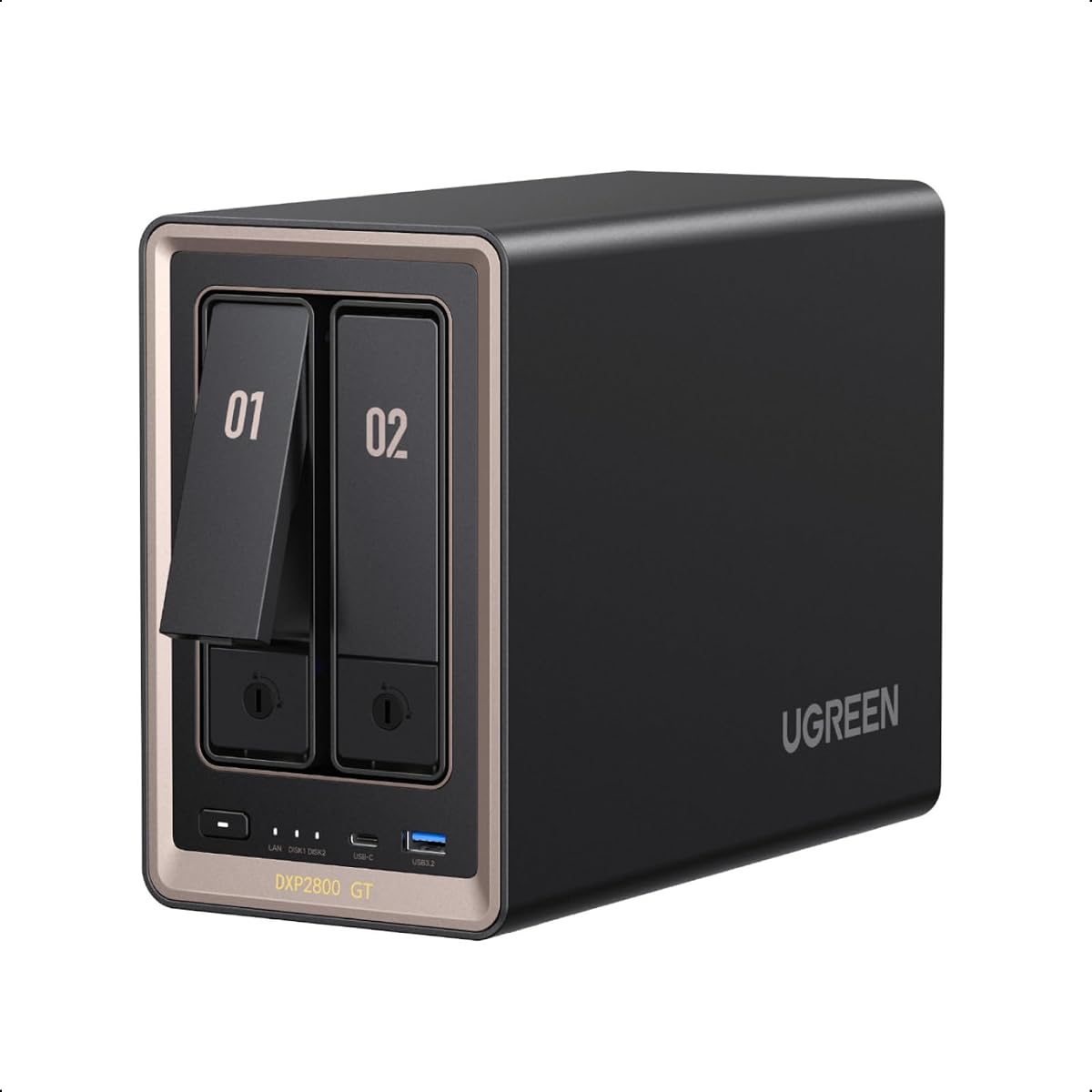
The UGREEN DXP2800 GT brings high-speed performance to a compact two-bay NAS enclosure. With a 4.2 rating, it balances power and size well for creators. It uses an AMD Ryzen processor and 10GbE networking for fast transfers. UGOS Pro provides a clean interface for managing files, backups, and apps like Docker or Home Assistant.
We may earn a commission when you buy through this link, at no additional cost to you.
Strengths include surveillance center capabilities for local camera storage. You can run virtual machines and self-hosted media servers locally. Encryption tools keep data private without cloud subscriptions. The 10GbE port significantly outpaces standard Gigabit speeds for large file workloads or shared team access.
Trade-offs involve only two SATA bays limiting total capacity to 80TB. Advanced apps require manual Docker setup and technical knowledge. RAM supports ECC upgrades but starts at non-ECC. These limits keep costs lower while maintaining speed. It fits freelancers or home studios prioritizing performance over massive storage.
Ideal for creators needing fast local cloud storage without enterprise costs. The DXP2800 GT delivers robust media workflow support. If you want a balanced device for backups, app hosting, and rapid file access, this model offers professional features in a compact, affordable package.
10GbE networking accelerates video editing and large file transfers. You can edit directly from the NAS without lag. The Ryzen CPU handles media processing tasks efficiently.
Built-in Surveillance Center supports ONVIF/RTSP cameras. Record footage locally to save cloud subscription fees. Manage and review video feeds through the UGREEN NAS app.
We may earn a commission when you buy through this link, at no additional cost to you.
The Synology DS925+ is a powerful four-bay NAS designed for advanced home and small office use. Its 4.2 rating reflects steady performance and reliable software. It uses an Intel Celeron processor with 4GB RAM. Dual 2.5GbE ports provide fast network transfer speeds and redundancy. DSM offers comprehensive file, photo, and virtualization features.
We may earn a commission when you buy through this link, at no additional cost to you.
Key strengths include built-in virtualization, surveillance, and snapshot recovery tools. You can run multiple users and applications smoothly. Encryption and granular permissions secure sensitive documents. The system supports SSD caching and expansion via the DX515 unit for additional capacity beyond initial bays.
Its fixed 4GB RAM limits heavy virtualization or Docker loads compared to higher-end models. No additional RAM slots exist for upgrades. These constraints suit users prioritizing reliability over massive multi-tasking. The three-year warranty offers extra peace of mind for critical data storage needs.
Best for users wanting robust security and app support. The DS925+ excels as a centralized hub for file sharing, media, and backups. If you need enterprise features in a home form factor with strong software longevity, this model delivers excellent value and stability.
Dual 2.5GbE ports keep data flowing if one link fails. Failover ensures continuous availability for critical services. Aggregate speeds support faster transfers for multiple users.
DSM supports virtual machines for running isolated apps or OS environments. You can test software or host servers separately. This flexibility adds enterprise-grade functionality to your home setup.
We may earn a commission when you buy through this link, at no additional cost to you.
The Synology DS425+ focuses on media streaming and team productivity with reliable diskless NAS performance. Its 4.6 rating highlights strong media handling capabilities. It supports up to 278 MB/s transfer speeds for smooth file sharing and streaming. The OS includes centralized document management with granular access controls and audit logs.
We may earn a commission when you buy through this link, at no additional cost to you.
Standout features include professional surveillance with support for 30 IP cameras and multi-layered data protection. RAID redundancy and automated backups prevent data loss. You can track access logs for compliance. Its enterprise support options add value for business-critical production environments needing dedicated account management.
Its processor limits heavy virtualization or multi-stream transcoding compared to Plus models. It remains focused on storage and file sharing. These limitations keep costs lower for users prioritizing reliability. The four-bay design offers ample space for growing media libraries and shared office documents.
Ideal for small businesses needing media hubs and secure collaboration. The DS425+ balances speed and functionality well for daily team use. If you require centralized storage with strong media capabilities and reliable backups, this model provides a practical solution for offices and home users.
Access and share large files securely across teams. Audit logs track who accesses what. Shared drives integrate with Windows and macOS seamlessly for easy collaboration.
Support for 30 cameras allows scalable security monitoring. Motion detection and remote access keep premises safe. Local storage avoids monthly cloud surveillance fees.
We may earn a commission when you buy through this link, at no additional cost to you.
The Synology DX515 expands your storage without building a new NAS. Its 4.6 rating reflects ease of use and reliability. It adds five bays to compatible DiskStation units. You configure new storage quickly via Synology DSM tools. Hot-swappable drives allow maintenance without powering down the system.
We may earn a commission when you buy through this link, at no additional cost to you.
Its primary strength is seamless integration with existing Synology ecosystems. You can merge volumes or keep them separate for flexibility. The unit supports RAID configurations similar to main units. The unified management interface lets you monitor health and replace drives easily through DSM's Storage Manager.
It has no standalone functions and depends on a compatible DiskStation to work. You cannot use it independently as a NAS. This limitation suits expansion needs well. Its three-year warranty ensures longevity matching your main system. The design maintains a quiet and compact footprint.
Best for Synology users needing more capacity over time. The DX515 offers cost-effective scaling without losing software benefits. If you want to grow your storage while keeping current data intact, this expansion unit provides the perfect bridge for long-term planning.
DSM tools let you combine expansion volumes with main storage. You can manage everything from a single interface. This simplifies administration for growing data needs.
Replace failed drives without shutting down the system. This minimizes downtime during maintenance tasks. The unit alerts you to issues early via health monitoring.
We may earn a commission when you buy through this link, at no additional cost to you.
The TrueNAS Mini X+ delivers advanced ZFS storage for enterprise and prosumer users. Its 4.3 rating reflects satisfaction with data integrity and performance. It includes 32GB ECC RAM and an 8-Core CPU. Dual 1/10 Gigabit ports enable high-speed network access. The system runs TrueNAS Community Edition for free and secure storage.
We may earn a commission when you buy through this link, at no additional cost to you.
Standout features include ZFS's self-healing properties, snapshot protection against ransomware, and broad protocol support like SMB, NFS, and iSCSI. You can enable remote management via IPMI for easy monitoring. It supports Windows, macOS, Linux, and Unix clients. The Mini X+ excels at data protection and workflow acceleration via cache SSDs.
Its complexity demands technical expertise for optimal use and tuning. Power requirements and heat output exceed consumer models. Despite this, the ZFS benefits justify the cost for critical data. You gain enterprise-grade redundancy, encryption, and performance in a compact mini-tower design for quiet desktop operation.
Best for users needing robust data integrity and high-speed access. The Mini X+ suits development, media distribution, or critical backup scenarios. If you require ZFS protection and advanced networking without building from scratch, this system offers a reliable, ready-to-deploy solution.
ZFS checksums and self-healing protect against silent data corruption. Snapshots shield against ransomware attacks or accidental deletion. RAID keeps data safe even if multiple drives fail.
IPMI remote management lets you monitor health and reboot remotely. This reduces the need for physical access. You can troubleshoot issues quickly and keep services running smoothly.
We may earn a commission when you buy through this link, at no additional cost to you.
Selecting the right diskless NAS enclosure requires balancing hardware specs, software features, and budget. Consider these critical factors to find a unit that grows with your data needs.
The number of drive bays determines maximum storage potential. Two-bay units suit personal backups while four-bay models handle growing libraries. Check total capacity limits and whether bays support SATA or NVMe SSDs for speed.
Choose enough bays to allow RAID redundancy without running out of space immediately.
Ethernet speed affects transfer rates between NAS and other devices. Gigabit is standard but 2.5GbE or 10GbE speeds benefit video editing or multi-user access. Dual ports offer failover redundancy for uninterrupted service.
Prioritize faster network ports if you move large files regularly.
OS quality defines ease of use and available apps. Synology offers intuitive DSM while TrueNAS provides ZFS power. Look for built-in tools like photo managers, backups, and surveillance apps tailored to your needs.
Select an OS that balances simplicity with advanced feature depth.
CPU and RAM handle multitasking like transcoding or virtual machines. Entry-level units suffice for storage but heavier loads need better processors. Expandable memory allows future upgrades for smoother performance.
Ensure specs match your intended workloads to avoid bottlenecks.
Security features include RAID support, encryption, and snapshot recovery. Encryption keeps data safe from unauthorized access while snapshots allow rolling back changes. Hardware RAID protects against physical drive failures.
Verify encryption standards and backup tools before purchasing.
Compact units fit on desks but may run hotter. Fanless designs reduce noise but limit cooling. Check dimensions to ensure your chosen NAS fits in your workspace quietly.
Prioritize noise levels if the unit will sit in living spaces.
Manufacturer warranty lengths range from two to five years. Good support ensures hardware issues get resolved quickly. Check availability of spare parts and online documentation.
Invest in brands with strong customer support for reliability.
Diskless units save costs upfront but drives add to the total price. Compare device prices and drive compatibility to calculate actual expenses. Some brands sell bundled options with drives included.
Factor drive costs into your overall budget before buying.
Begin installation by inserting compatible SATA or NVMe drives into the bays and securing them with screws. Power on the device and follow setup wizards to install the OS and configure network settings. Most units include a QR code or app for mobile setup guidance.
Configure RAID or volume settings to match your reliability needs. Enable automatic backups to external drives or cloud services for layered protection. Set up user accounts with permission levels to keep data organized and secure.
Maintain your NAS by keeping firmware updated to patch security vulnerabilities. Ensure proper ventilation around the unit to prevent overheating. Monitor drive health regularly through dashboard tools to address warnings before failure occurs.
Yes, diskless models let you choose compatible drives which simplifies hardware setup. You insert drives and use guided software wizards to initialize them. This avoids pre-installed drive limitations and lets you start with your preferred storage capacity.
Yes, most NAS units allow mixing brands and capacities though same size is ideal for RAID. Different sizes are handled via JBOD or individual pools. Ensure drives are compatible with the manufacturer's official compatibility list.
Diskless NAS gives you full control over hardware and data without monthly fees. You avoid subscription costs and keep data local for faster access. Security is managed by you rather than a third-party provider.
Most support remote access via apps or web portals though speeds depend on internet upload. Some require port forwarding or VPN setups for secure connections. Verify features like QuickConnect or Tailscale before purchasing.
Enable snapshot features that preserve file versions before encryption occurs. Use user accounts with limited permissions and strong passwords. Store backups offline or offsite to recover data if the main unit gets locked.
Yes, diskless units are designed to accept larger or additional drives later. Some support expansion bays while others need swapping drives for more space. Check if the model allows RAID migration to avoid data loss during upgrades.
Basic storage works with standard broadband but remote media streaming benefits from faster upload speeds. Use quality networking gear like Gigabit or 2.5GbE routers for best performance. Heavy simultaneous access may require upgraded internet speeds.
Our top picks cover diverse needs from budget-friendly home storage to professional-grade solutions. The Yxk Zero1 and Synology DS223j offer great value for personal use while the UGREEN DXP4800 GT leads in performance for creators.
Prioritize factors like drive bays, software ease, and network speed when making your decision. Consider future expansion needs and data protection tools to ensure long-term satisfaction. A diskless NAS gives flexibility to customize your storage environment exactly as you prefer.
Prices and availability fluctuate frequently so verify current listings before purchase. Check compatibility with your existing hardware and plan for drive costs separately. Investing time now ensures you choose a model that serves your data needs reliably for years to come.