
SUNLU Filament Dryer S2
4.3Editor score
Fast heating and even drying
Simple touch screen controls
Large capacity for spools
This guide compares the top 10 filament dryers for 3D printing based on capacity, heating speed, and humidity control to help you choose the right model for
Choosing the right filament dryer for 3D printing is essential for achieving high-quality prints. Moisture in filaments causes stringing, bubbling, and poor adhesion. A good dryer removes moisture efficiently and keeps spools ready for use.
We compared ten top models based on capacity, heating technology, and ease of use. Each product was evaluated for its ability to handle different materials like PLA, PETG, ABS, and Nylon. Our analysis focuses on performance and reliability.
Each pick shows key features and real-world usability for makers and professionals. Prices and availability may change, so check the links for current offers. Read our detailed reviews to find the best fit for your printing needs.
4.3Editor score

4.6Editor score

4.5Editor score
This side-by-side comparison highlights the key specs of all ten dryers to help you decide quickly based on your specific printing volume and material needs.


The Creality Filament Dryer Box 4 Spools is a top choice for users needing to manage large printing volumes. It offers a spacious design that holds up to four 1kg spools simultaneously, ensuring you never run out of dry filament.
We may earn a commission when you buy through this link, at no additional cost to you.
Its dual independent heating chambers provide a significant advantage by drying filament 30% faster than single-chamber models. This feature allows you to achieve print-ready results in hours rather than days, reducing downtime effectively.
While the price is higher than budget options, the investment is justified by the capacity and advanced control features. The touch UI lets you customize settings for various materials, making it versatile for diverse printing projects.
This model is ideal for professionals or hobbyists who print frequently and use high-performance materials. If you need reliable drying and storage for multiple spools, this dryer delivers consistent quality and performance.
Dual chambers remove moisture faster, ensuring spools are ready when you are.
Higher temperature ranges allow drying of ABS and other demanding materials.
We may earn a commission when you buy through this link, at no additional cost to you.
The SUNLU S4 is designed for those who run multiple printers or need high throughput. Its standout feature is the eight filament exit holes, allowing you to feed different printers from one unit easily.
We may earn a commission when you buy through this link, at no additional cost to you.
Equipped with a 350W PTC heater and three circulation fans, it ensures even drying across all spools. This power means you can dry materials quickly and maintain consistent quality across different filament types.
The dryer also offers DIY customization, letting you adapt it for larger spools or other uses. However, its size requires significant space on a desk or workbench, which might be a limitation for small studios.
If you operate a multi-printer farm, the S4 is the best solution. It simplifies filament management and keeps materials dry for simultaneous jobs, boosting your overall printing efficiency.
Eight exit holes allow feeding multiple printers from one dryer efficiently.
Users can modify the unit to fit unique spool sizes or needs.
We may earn a commission when you buy through this link, at no additional cost to you.
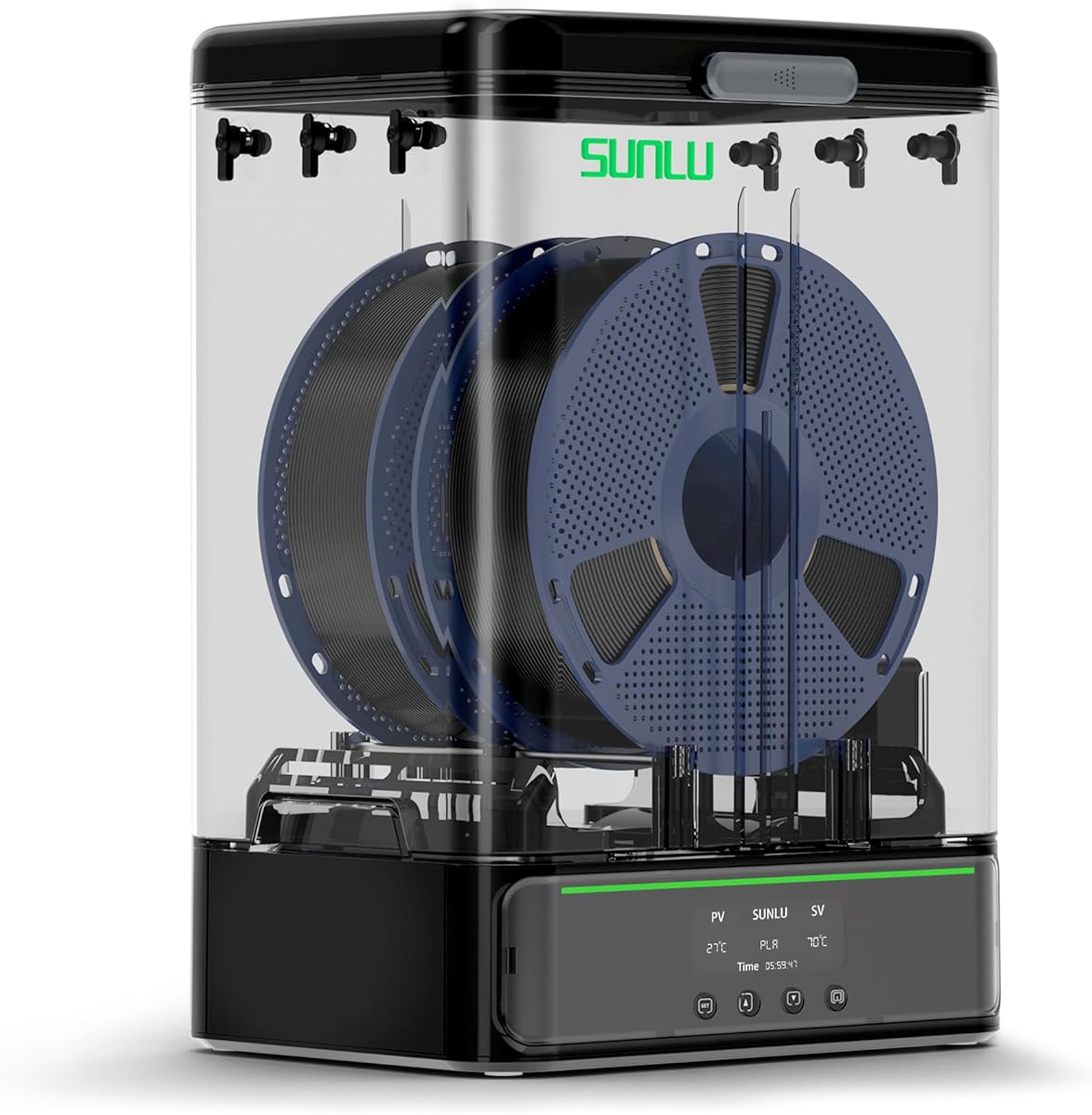
The SUNLU S2 is an excellent starting point for anyone new to filament drying. It offers essential features like even heating and easy controls without a high cost, making it accessible for most makers.
We may earn a commission when you buy through this link, at no additional cost to you.
Its spindle ensures continuous spinning during drying, which helps remove moisture uniformly from the filament. This prevents hotspots and ensures the spool is ready for consistent printing results.
While it lacks some advanced features found in higher-end models, it covers the basics very well. The translucent lid lets you check on spools without opening the box and maintaining the environment.
For hobbyists or casual users, this dryer provides great value. It effectively revives damp filament and keeps spools dry, solving common issues like stringing without breaking the bank.
Built-in spindle ensures the filament spins for even heat distribution.
Translucent lid allows monitoring without opening the box.
We may earn a commission when you buy through this link, at no additional cost to you.
The SUNLU S1 Plus stands out with its upgraded fan design that speeds up moisture discharge. This feature helps solve problems like stringing caused by wet filament quickly and effectively.
We may earn a commission when you buy through this link, at no additional cost to you.
Its visual display shows temperature, time, and humidity in real time. This transparency allows you to monitor the drying process accurately and adjust settings as needed for optimal results.
The personalized settings let you adjust the temperature between 35C and 55C. This range is sufficient for most common filaments like PLA, PETG, and ABS, ensuring good print quality.
This dryer is great for users in humid environments. The fan and adjustable settings ensure that filament stays dry even when weather conditions are challenging, keeping your prints consistent.
Fan design helps move excess water out of the box efficiently.
Display provides accurate readings of internal conditions.
We may earn a commission when you buy through this link, at no additional cost to you.
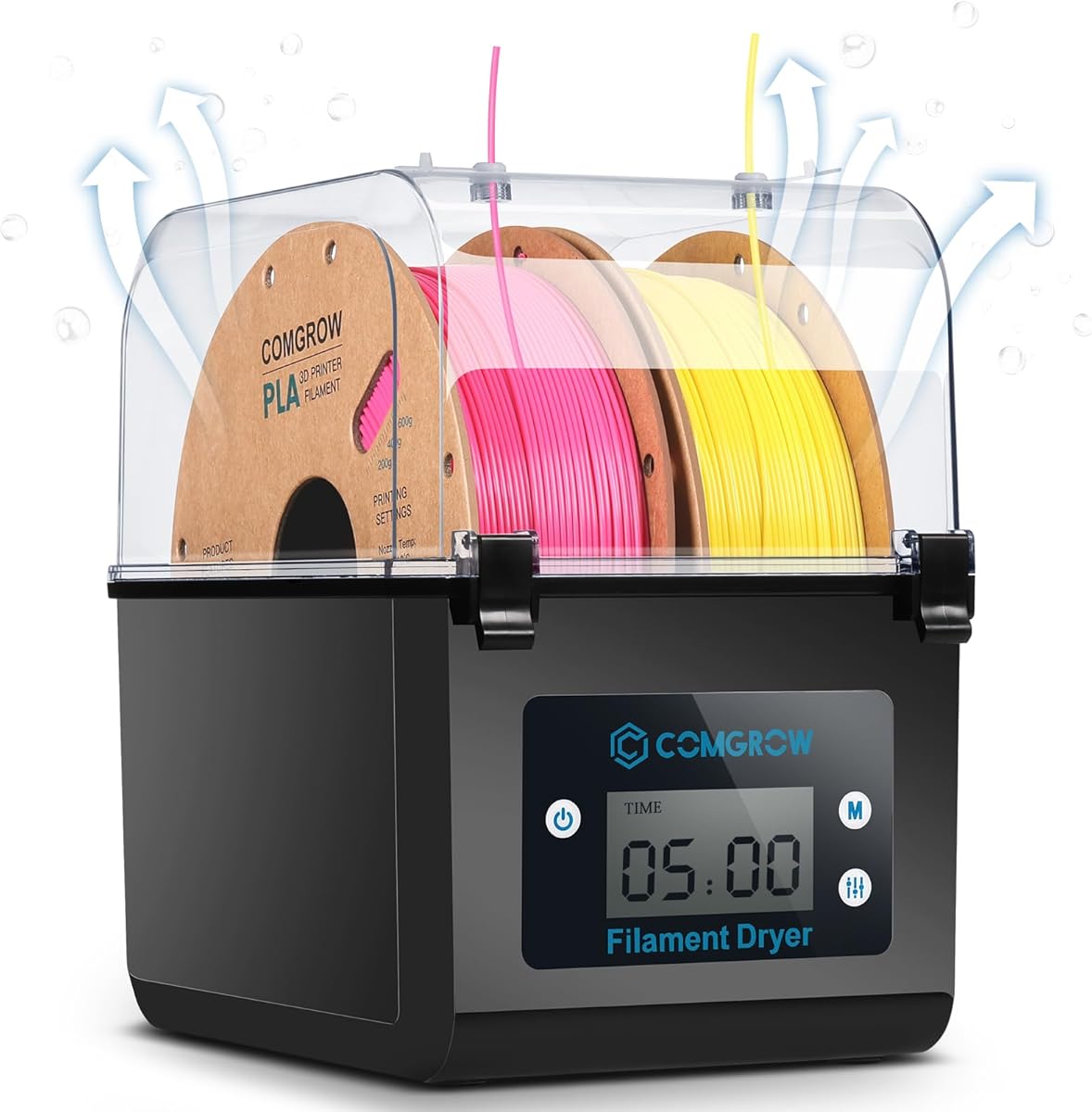
The Comgrow SH01 is a reliable dryer focused on keeping filament dry during and after printing. Its large storage volume accommodates two rolls, making it convenient for small to medium projects.
We may earn a commission when you buy through this link, at no additional cost to you.
The LCD screen and touch buttons make it easy to set temperature and duration. Real-time monitoring ensures you know exactly what is happening inside the box, reducing guesswork.
The sealing performance is enhanced by silicone cable sheaths and a snap button cover. This keeps moisture out effectively, although you must ensure the sealing hole is closed when not in use.
This model is perfect for users who want simplicity without sacrificing quality. It protects your filament from dampness and helps avoid common issues like clogging and poor adhesion.
Silicone sheaths and snap buttons help keep the environment dry.
Touch buttons and screen simplify the operation.
We may earn a commission when you buy through this link, at no additional cost to you.
The SUNLU SP2 supports larger spools up to 3kg, which is great for long prints. It heats up quickly and maintains steady heat for even drying of your filament.
We may earn a commission when you buy through this link, at no additional cost to you.
Its superior sealing storage ensures filament stays dry after drying. The sliding latches and gaskets create a tight seal, protecting against moisture re-absorption effectively.
The built-in hygrometer and desiccant containers help monitor humidity levels. This helps keep your filament in the best condition over time, ensuring better print quality.
If you often use large spools, the SP2 is a top choice. It combines drying and storage capabilities, making it a comprehensive solution for your filament management needs.
Rollers hold 3kg spools for convenient long printing.
Latches and gaskets ensure the storage remains dry.
We may earn a commission when you buy through this link, at no additional cost to you.
The SP2 uses 360 surround heating to dry filament evenly. This technology ensures that all sides of the spool receive consistent heat, reducing the risk of uneven drying.
We may earn a commission when you buy through this link, at no additional cost to you.
It is designed to operate quietly, which is beneficial for home offices or shared spaces. The sound level is low, allowing you to work without distraction while printing.
The control panel provides different presets for various filament types. This makes it easier to use, as you do not need to calculate settings manually for common materials.
For users seeking a quiet and efficient dryer, the SP2 is a great option. It handles common materials well and provides a good balance of features and usability.
Surround heating ensures consistent drying across the spool.
Low noise levels make it suitable for quiet environments.
We may earn a commission when you buy through this link, at no additional cost to you.
The Creality Space PI Plus features one-key settings for 12 filament types. This makes it very easy to use, as you simply select the material you are using.
We may earn a commission when you buy through this link, at no additional cost to you.
The 110W PTC heater ensures quick and uniform drying. This efficiency is helpful if you need to dry filament before a print job starts quickly.
The touch screen allows switching between temperature units easily. This flexibility is great for users who prefer Fahrenheit or Celsius based on their location.
If you work with different filament types regularly, the presets save time. It is a convenient dryer that handles various materials well with minimal setup.
Presets remove the guesswork from drying different materials.
The screen is easy to use and clear to read.
We may earn a commission when you buy through this link, at no additional cost to you.
The Polymaker Polydryer combines drying and storage into one unit. This design allows you to move filament from drying to printing without breaking the seal.
We may earn a commission when you buy through this link, at no additional cost to you.
The built-in hygrometer helps you judge filament status with less guesswork. It supports day-to-day management by showing you when the filament is dry.
The integrated approach uses heat, seal, and desiccant to protect filament. This ensures that your filament remains dry over time, even between printing sessions.
If you want a complete solution, this dryer offers reliable results. It is easy to use and covers all the bases for moisture control effectively.
Design keeps filament sealed to prevent moisture reabsorption.
Built-in monitor makes it easy to track humidity levels.
We may earn a commission when you buy through this link, at no additional cost to you.
The Creality Space Pi SE is a compact dryer that heats up quickly. It is ready to use right out of the box, saving time on setup.
We may earn a commission when you buy through this link, at no additional cost to you.
The thermal insulation cotton helps keep warm and prevents scalding. This adds a layer of safety and efficiency to the drying process.
Real-time humidity monitoring ensures you can track drying conditions easily. This helps you manage your filament better and avoid issues related to moisture.
For users with limited space, this dryer is a great fit. It covers essential needs like drying and storage for common materials well.
PTC heater ensures fast heating for quick drying.
No assembly required allows immediate use.
We may earn a commission when you buy through this link, at no additional cost to you.
Choosing the right dryer depends on your printing habits, filament types, and budget. Here are the main factors to consider.
Capacity determines how many spools you can dry at once. Most models hold 1kg spools, but some support larger 3kg rolls. Consider how many spools you need to manage for your projects.
Choose a capacity that matches your printing volume. If you run multiple jobs, a larger dryer saves time.
PTC heaters are common and efficient. They warm up quickly and maintain temperature well. Some models use heating pads, but PTC is preferred for uniform heating.
Look for a model with good heating speed to reduce downtime. Efficient heaters mean less waiting for filament to be ready.
Different materials need different drying temperatures. PLA is safe at lower temps, while Nylon requires higher heat. Ensure the dryer covers the range needed for your materials.
Check the max temperature. If you use advanced filaments, choose a dryer that supports higher temps.
Built-in hygrometers help track internal conditions. This prevents over-drying or under-drying. It is a useful feature for precision.
Monitor humidity levels to maintain filament quality. This helps you know when drying is complete.
Good sealing keeps moisture out after drying. Look for tight seals and rubber gaskets. This ensures filament stays dry between prints.
Choose a dryer that can also act as storage. This saves space and simplifies workflow.
Controls should be simple. Touch screens or knobs are preferred. Complex interfaces can slow you down.
Look for presets to make setup easier. Simple operation improves your daily experience.
Durability matters for long-term use. Look for sturdy materials and good construction. This ensures reliability.
Quality builds reduce risk of failure. Check reviews for durability feedback.
Prices vary widely. Budget models offer basics while premium models offer capacity and advanced features. Decide what matters most.
Balance cost with your needs. The best value is what fits your workflow.
Set the temperature and timer according to your filament type. Most dryers have a range of 40C to 70C. Avoid exceeding max temps to prevent melting.
Close the door tightly to maintain the seal. This ensures humidity does not enter. Check the gaskets periodically for wear.
Clean the dryer regularly to remove dust. Use a soft cloth. Proper care ensures the heater works well over time.
Not all filaments absorb moisture equally. PLA and PETG absorb moisture slowly. Nylon and TPU absorb moisture quickly. If you store filaments in dry places, drying may not be needed for all. But printing in humid conditions often requires drying for good results.
Drying time depends on humidity and material. It can take from 4 to 24 hours. Some models offer fast modes. Check the manufacturer guidelines for specific materials.
Many dryers allow drying while printing. This keeps filament dry during the job. It helps prevent issues. Make sure the exit is connected properly to the printer.
PLA dries well around 45C to 60C. Do not exceed 70C as it may soften. Check the material recommendations for best results.
Wipe the inside with a dry cloth. Do not use water near electrical parts. Clean the fan blades if needed. This keeps the unit working well.
Yes. Some focus on drying only while others offer storage. Storage dryers seal better. Choose based on if you need to keep spools dry for long periods.
Dryers use moderate power. Typical models use less than 350W. This is similar to a light bulb. It is not expensive to run.
High temps can deform spools or melt filament. Use recommended settings. If you see plastic softening, reduce heat immediately.
Our top picks offer options for every user. The SUNLU S2 is great for budget buyers. The Creality Dryer 4 Spools is best for volume. The SUNLU S4 is ideal for multi-printer setups.
When choosing, consider your printing volume and material types. Capacity and sealing are critical for consistency. Ensure the model matches your needs.
Check current pricing and availability. Prices change often. Select the model that offers the best value for your specific workflow and budget.